
Critical Forklift Dimensions to Know Before Heading Out…
…not only in height, but also length and width.
We’ve all heard about those unfortunate incidents of trucks driving on car-only parkways and having an untimely meeting with an overpass. Ouch! You need to be aware of the same thing happening to you and your forklift. Alternatively, you don’t want to find your forklift wedged into an aisle where it can’t move.
All forklifts were not created equal. Different forklifts have different dimensional limitations, and forklift operators need to be thoroughly aware of those limitations, especially if you’re using more than one type or brand of forklift. Always remember safety first!
Here’s a rundown of the important forklift measurements to help you avoid knocking off a sprinkler head or getting jammed up in a too-narrow aisle.
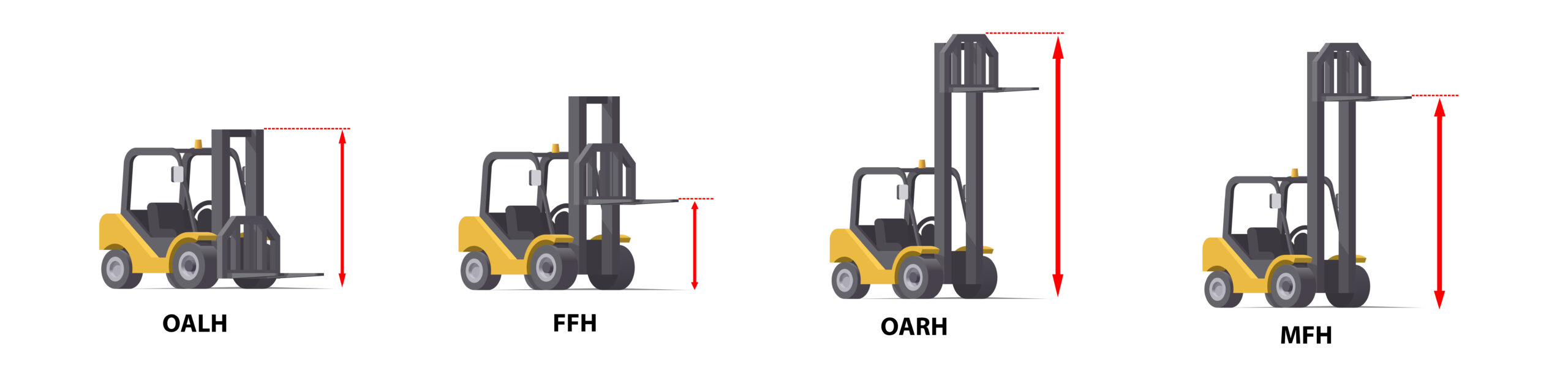
- Overall Lowered Height (OALH) This is the height of the forklift mast with the forks in their lowermost position. This is important to know for cruising around the warehouse or driving into a trailer on the dock for loading or unloading. Be aware of ceiling fixtures like sprinklers, lights, hanging ventilation units, fans and electrical conduits. Sometimes they’re lower than they seem. Use caution when driving through rack tunnels.
- Overall Raised Height (OARH) When the mast is fully extended, this is the dimension from the floor to the top of the mast. It’s important to know this height—especially if your warehouse has multi-tiered racks. Again, be cognizant of utilities and HVAC units mounted on the ceiling. You don’t want your mast to go crashing into the overhead lights when you’re picking up that pallet from the highest rack.
- Free Fork Height. (FFH) This forklift measurement is the height of the forks from the floor when they are raised to a position before the mast starts to extend. FFH is important to know when your headroom is limited, like unloading a double-stacked trailer truck. Or if you’re removing double-stacked pallets on the floor from a drive-in system when there are pallets on rails stored above you. Otherwise…look out below.
- Maximum Fork Height (MFH) You’ve made it to the top! MFH is the highest position the forks can achieve. While this seems like an obvious dimension, it needs to be taken into account, especially in a warehouse that has racking of different heights. Don’t forget that MFH has to be at least 8 in. higher than the level of the highest pallet to allow for lifting the pallet before storage or removal.
Note – The forklift’s rated load capacity is based on weight distribution as much as it is with load weight and size. The intent is for loads to be centered with the weight evenly distributed across the forks. Irregularly shaped, unbalanced, or loads not placed at the back of the forks may cause you to exceed the rated load capacity found on the forklift’s data plate. To learn more about choosing the right forks for the job, check out our blog: Forklift Forks – A Two Pronged Approach to Selection & Maintenance
Forklift Dimensions – The Wedge Effect
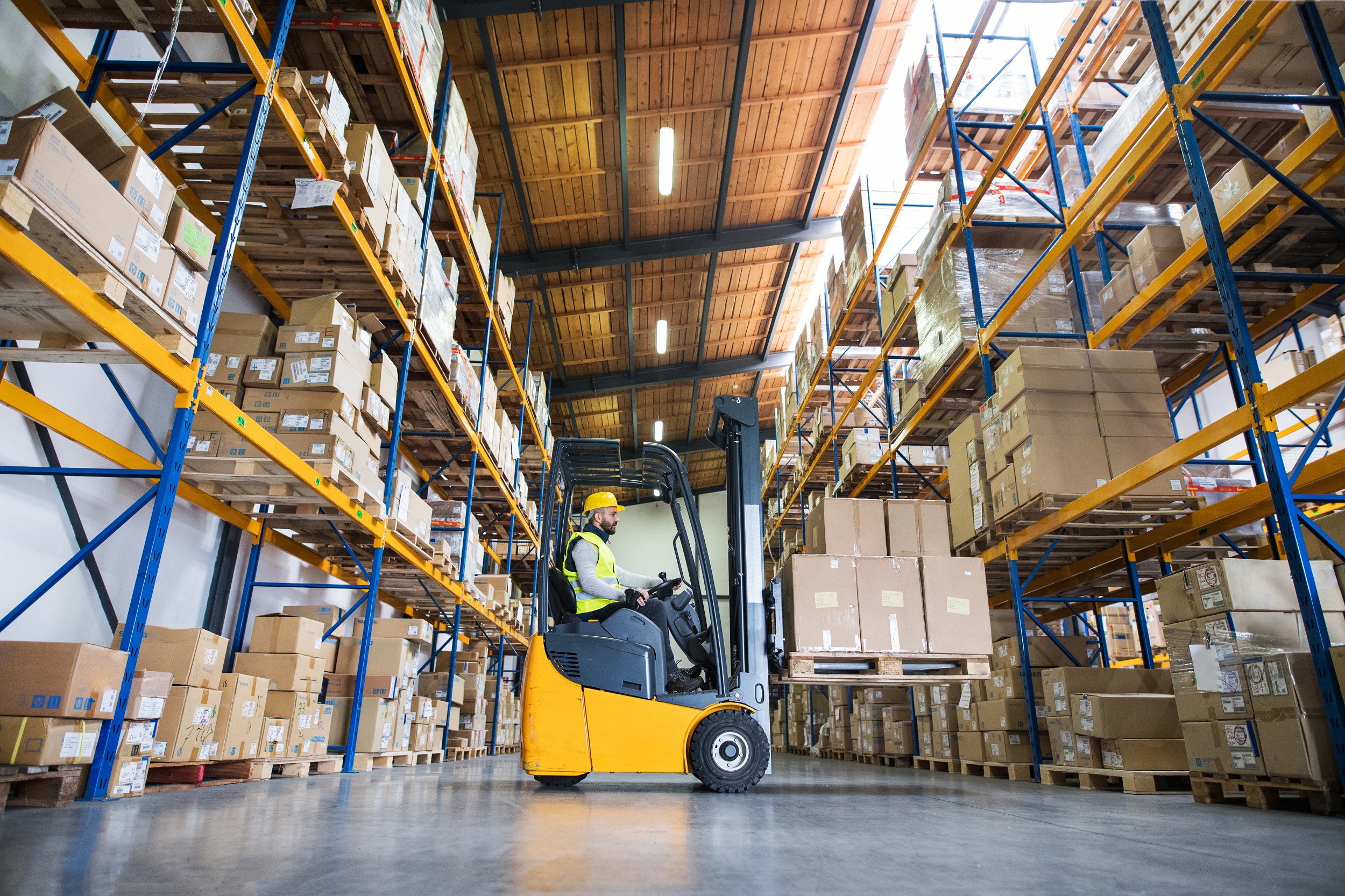
Vertical forklift measurements are not the only ones that must be taken into account when operating a forklift. We all know that experience of having your parked car wedged in by a guy who squeezes right up to your bumper – not good. Or, trying to maneuver past the double-parked delivery truck on a narrow street.
To a great degree, aisle width determines the length dimension of the forklifts you can use in your warehouse. Some facilities are designed for standard pallet rack with wider aisles, while others plan for very dense storage with very narrow aisles. Here are the forklift dimensions for choosing a forklift at an existing warehouse.
Your Go-To Forklift Length Measurements 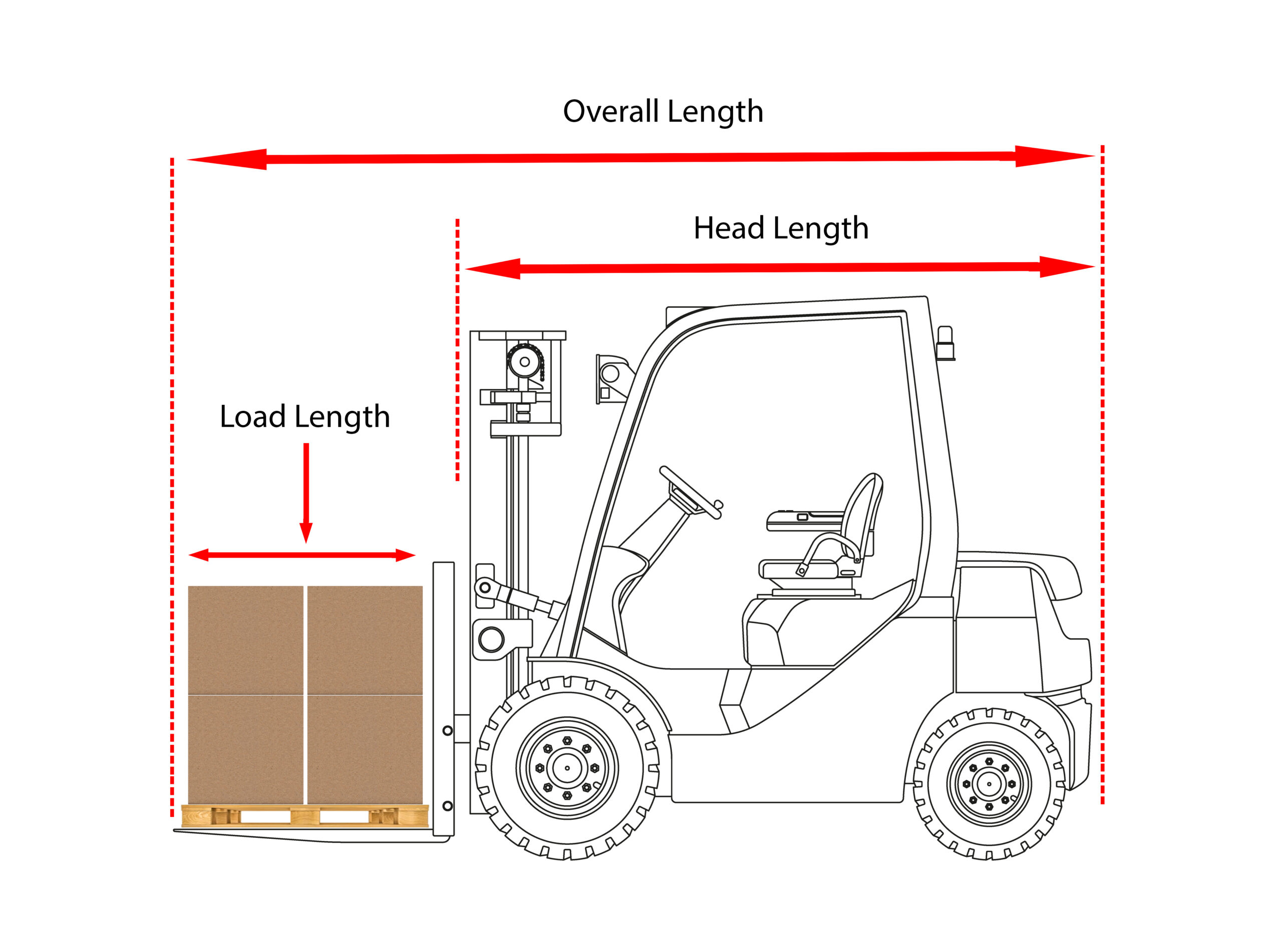
- Head Length – This is the length of your forklift from the back of the truck to the front of the load backrest.
- Load length – The length of the pallet along the stringer plus any product overhang
- Overall Length (OAL) – This is the sum of the above two dimensions.
- Right Angle Stack Length – This forklift measurement is the smallest space within which a forklift can make a 90° turn and is similar to head length.
To calculate minimum rack-to-rack aisle width for a forklift, use the formula:
Right Angle Stack Length + Load Length + 12 in. (for maneuverability) + 6 in. (for pallet overhang)
Aisle Widths – Rules of Thumb for Different Forklift Types
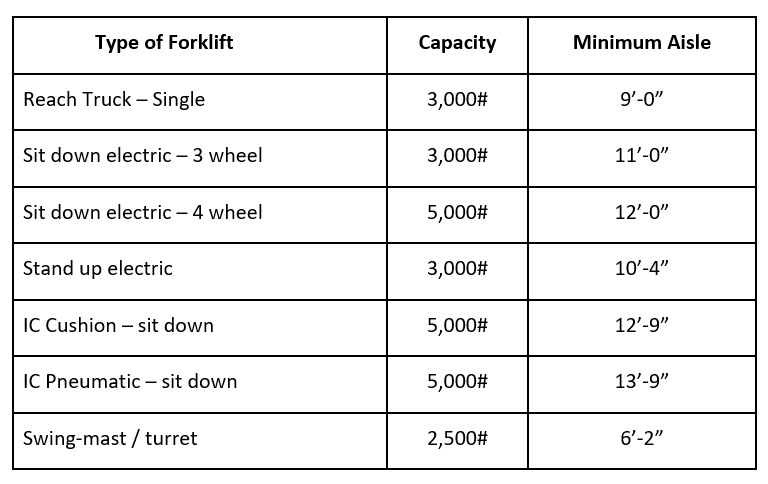
Generally, a sit-down, counterbalanced forklift requires a wide aisle of 11 to 14 ft. A stand-up counterbalanced forklift can fit into a tighter space, typically 11 to 12 ft. depending on the model. Warehouses designed with narrow aisles, say 9 ft. wide, require the use of a reach truck to safely clear the aisles and load and unload pallets. For very narrow aisles, those that are less than 9 feet, a swing-reach or turret truck must be used. These are usually accompanied by a forklift guidance system.
Width is also an important forklift dimension to consider, especially if your forklift is equipped with outriggers to increase stability. This is an especially important measurement in drive-in rack setups.
Note that all the above forklift dimensions are just guidelines. Actual measurements of aisle widths and forklift dimensions should be made to ensure maximum productivity and safety. Use of attachments also changes all the above assumptions, since these have their own sets of dimensional limitations.
Your Apex forklift application specialist is the best resource for helping you determine the right forklift for your specific application. We can provide a recommendation for the forklift that offers you the best combination of productivity, efficiency and safety. We can also provide training for new or existing workers to get them up to speed on best practices in forklift operation. Just give us a call at 833-226-4573.