The Right Forklift Fork for the Job
Forklift forks play a vital role in safely and effectively carrying and moving loads of raw materials, finished goods inventory, equipment, and more. However, not all forks are created equal. They come in different sizes and designs to meet the vast array of industrial forklift needs. Correctly measuring your forklift’s forks for your specific application and understanding the signs of wear and tear will protect your investment and improve the effectiveness and safety of your operation.
Understanding the Elements of a Forklift Fork

Forklift forks can also be referred to as blades or tines. Different styles of forks have specific rated load capacities to satisfy the requirements of each type of forklift. The individual components of a forklift fork are:
- Tip – End of the blade — the first point of contact with loads at the insertion point.
- Blade – Lower part of the L-shaped fork that supports loads during movement and carrying.
- Shank – Upright support of the L-shape that supports the blade at the bottom.
- Heel – Connection point between blade and shank of the fork.
- Hooks – Located on the upper and lower part of the shank to attach to the forklift.
- Pin Lock – Mechanism placed on the top hook used to change the positioning of forks once they’re on the vehicle carriage. Also known as locking pins and latch pins.
- Taper – Point of the blade that makes it possible to pick up the load. There are several levels of taper thickness.
Fork construction follows universally accepted production standards, including high-grade steel and alloys, comprehensive heat treatment, and automated welding of upper and lower hooks.
As a vital element of your forklift operation, inspect the condition of your forks as part of your forklift routine maintenance. OSHA recommends that operators conduct daily inspections of the vehicle before use to ensure safe operation. See below for specific evaluation guidelines.
Different Types of Forklift Forks
Although the general anatomy of forklifts might be standard, there are many different types of forks to suit your operational needs. Forks are selected based on vehicle model, purpose, and application. Types of forklift forks include:
- Pin and Bar Type Forks – Fit onto the carriage with a locking mechanism that secures the fork to the actual vehicle.
- Drum-Handling Forks – Groove cut out to safely carry and load drums of liquid, like oil or water.
- Coil-Handling Forks – Forks with beveled edges provide a safe and secure resting spot for coils during load transport.
- Explosion-Proof Forks – Forks clad in at least two-millimeter-thick stainless steel to prevent spark or explosion in dangerous environments.
- Food Production Industry Forks – Forks explicitly used for food service or production venues. Generally coated in stainless steel and require routine deep cleaning.
Different forks are available for unique jobs, including anti-slip forks, block forks, folding forks, fully tapered forks, offset and inset forks, and lumber forks. So, if you’re looking for the right utensil for your job, the professionals at Apex have your fork.
Time to Replace Your Forklift Forks? Look for These Tell-Tale Signs

There are five tell-tale signs of fork breakdown and deterioration to include in your routine inspection. When measuring wear and tear on your fork, look for cracks, bends, twists, damage to weld integrity, and wear and tear on the heel. Remember the following:
- Heel Thickness – ISO standards dictate that forks’ heel thickness is not less than 10 percent of its original heel thickness; once it goes below 90 percent, it’s time to replace the fork.
- Fork Bend – Set a go/no gauge to a 90-angle and set it on top of the forks. If the gauge maintains a 90-degree, there is no or minimal bend to the fork.
- Difference in the height of Fork Tips: if the difference in tip heights exceed 3% of the length of the blade, the set of forks should be taken out of service.
- Blade Thickness – A 10 percent decrease in thickness equates to a 20 percent decrease in load capacity. Measure the thickness of the shank. The shank does not usually wear down, so it’s a good measurement of the original thickness of the blade.
- Damaged or Bent Hooks – Check to see if calipers contact the hooks; replace them if they are.
For more information on your thorough annual forklift inspection, take a look at our blog: Inspecting Forklift Forks and Chains – Taking a Closer Look
It’s best to have an experienced and qualified professional conduct the inspection of your forks, so you have peace of mind and assurance of operability throughout their active use.
Let Apex Help You Keep Your Forks in Prime Condition
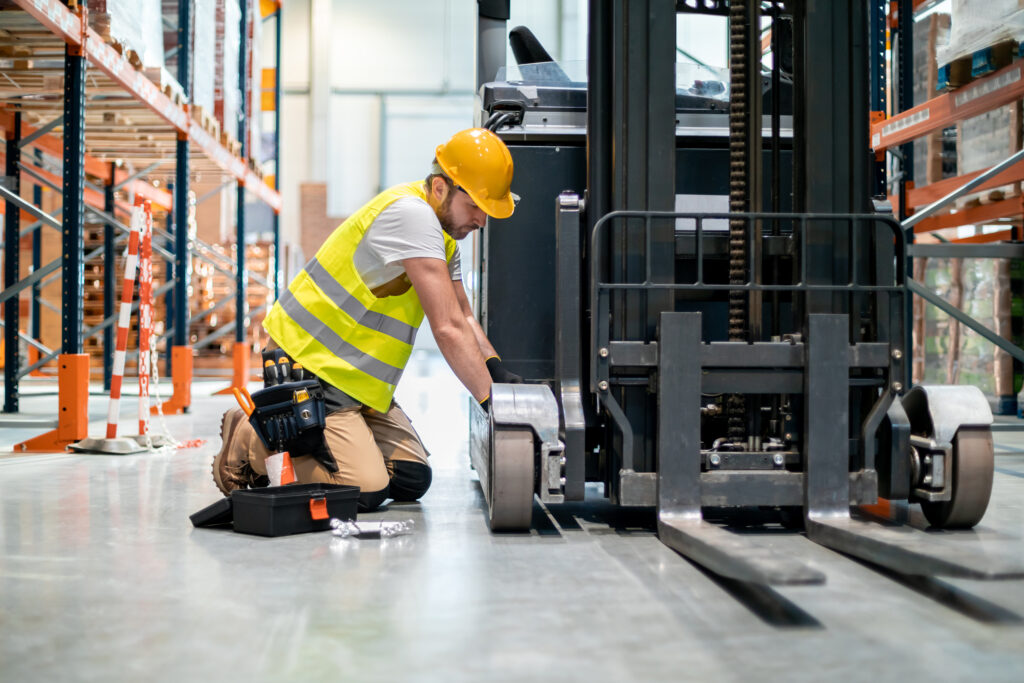
The Apex Full Fleet Management Program provides comprehensive maintenance and inspection of your forklifts, including external and internal parts. We offer a 70-point inspection to ascertain the prime working quality of every single element of your vehicle. Regular maintenance helps you keep service costs down by staying ahead of major repairs and ensures a longer, more productive vehicle life.
Apex Forklift Field Service and Maintenance:
- 24-Hour On-Call Forklift Service
- Factory-Trained Technicians
- Fully Stocked Service Vans
- Portable Welding
- Fair, Competitive Pricing
- Free Scrap Pick-up
Contact Apex today to learn more about our Fleet Maintenance Program and sign up to begin protecting your warehouse vehicles. We service the broad Chicago metro area.