
What Forklifts Work Best for Different Forklift Aisle Widths?
The forklift operator’s worst nightmare: getting wedged in an aisle that’s too narrow for the forklift and the load that you just picked up. Must not have heeded the minimum forklift aisle width rule.
How do you avoid that unpleasant scenario? Simple. Pay attention to the specs of your forklift and understand how to calculate minimum aisle width.
How to Calculate Minimum Aisle Width
Every forklift comes with a dimension known as Right Angle Stack. This dimension is the smallest turning radius of the forklift with a standard load. Using this dimension, you can calculate the minimum aisle width within which your forklift can maneuver. We’ve covered this calculation in a previous blog on forklift dimensions, but let’s review it in this blog and look at forklifts that work comfortably in different standard rack-to-rack warehouse aisle widths.
|
The formula for determining minimum aisle width is: Minimum Aisle Width = Right angle stack + Load length + 12 in. |
The 12 in. added to the formula generally gives you enough room to maneuver your forklift in the aisle. This formula works as long as the load doesn’t overhang the pallet. If your loads routinely overhang their pallets, it’s best to add the length of the typical overhang you have, and be aware of the fact that if the load significantly exceeds that extra cushion, you may run into a problem maneuvering the load in the aisle. Many forklift specialists recommend adding another 6 in. Let’s look at an example of an aisle width calculation.

The Clark ECX 30 is a versatile electric forklift ideal for warehouse use. Let’s take a look at its dimensions.

The ECX30 has a right angle stack of 91.3 in. Let’s assume you are moving stuff loaded on standard 48 in. GMA pallets.
91.3 in. + 48 in. + 12 in. = 151.3 in.
Minimum aisle width is 151.5 in., or 12.61 ft. You’ll need a warehouse with 13 ft. rack–to-rack aisle width to accommodate the ECX30. This gives you a little cushion–about 4½ in.–in
case you have loads that overhang their pallets. If you are routinely moving pallets with overhang, you might want to opt for the slightly smaller ECX25, which will give that 6 in. cushion, but sheds 1,000 lb. in capacity (5000 lb. vs. 6000 lb. for the ECX30)
What Forklifts Can I Use For My Warehouse?
Clearly, warehouse aisle width is a major determinant of what forklifts you’ll be able to use. With the pressure of trying to optimize warehouse space, and fit as much product within a given area, warehouse designers have been reducing aisle widths as much as possible.
Going from a warehouse with 12 ft. aisles to one with 8 ft. aisles can add as much as 20% more storage capacity. Traditionally, warehouses were designed with 12 to 13 foot aisles, and many older facilities as well as those warehouses storing large, bulky items still use that aisle width or wider. Let’s review the options.

Take a closer look at how to pair these parameters with vehicle types:
|
12 to 13 ft. Aisle Width With wide aisles like this, you can opt for one of the Clark ECX series as we saw in the above example. If you prefer an IC-powered truck, the Clark C12C with cushion tires and a right angle stack of 90.7 in. should work well in your application. |
 |
| If you’d like to go the Li-ion route and choose a BYD forklift, you can choose the ECC22, which features 4,850 lb. capacity, cushion tires and a right-angle-stack of 87.2 in. |  |
|
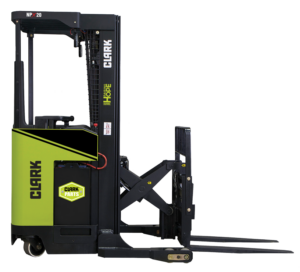
10 ft. Aisle Width If you need to move pallets in a warehouse with this aisle width, you need to look at narrow-aisle forklifts, such as the Clark NPX20. With its 46 in. right-angle-stack, 3000 lb-capacity, and cushion tires, this stand-up vehicle can comfortably maneuver in a 10 ft. aisle. |
 |
| Another option is the Big Joe J2 Joey, a stand-up forklift that features a 2,000 lb. lifting capacity. | 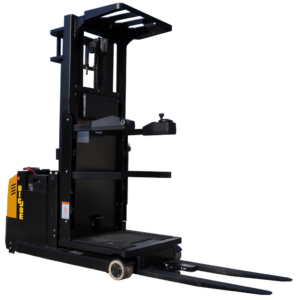 |
|
8 ft. Aisles A warehouse with 8 ft. aisles limits your choices of pallet movers to turret trucks such as the Clark ECX30 (electric) or C30C (IC). These innovative forklifts have the ability to maneuver in very narrow aisles and incorporate a swing-lift mechanism to place pallets on racks. |
 |
| Another option is a walkie reach stacker such as the Big Joe PDSR. Its compact design and pantograph mechanism allows the operator to turn in a tight circle and extend the load to place it on or lift it off a rack. Its 3,000 lb. capacity gives you the capacity of a forklift in a small, maneuverable package. | 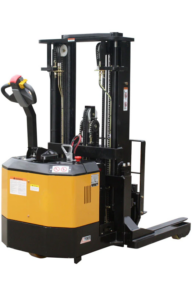 |
Don’t forget that these calculations only apply to forklifts without attachments. Adding an attachment to a forklift will substantially increase the minimum aisle width.
Contact us!
The information presented here is simply to understand how to calculate minimum aisle width and give you a look at the pallet moving options for different standard aisle widths. For a much more detailed analysis of the forklift options that work best for your warehouse, contact one of your Apex representatives–the best source for selecting material handling vehicles in the Chicagoland area. And don’t forget that when using some of these specialized narrow-aisle pallet movers, operators need additional training to provide the best combination of efficiency and safety.