
Both types of Powered Rider Pallet Trucks Have Their Pros and Cons. Let’s Review Them
The decision to invest in a rider pallet truck often begins with upgrading from a manual or powered pallet jack. If increased pallet volume or longer travel distances are slowing your team down, it’s usually a sign that it’s time to step up to a rider.
Before you pull the trigger, it’s wise to make sure your choice of pallet truck matches the application you plan to use it for. This blog will help you make that decision.
What Is a Rider Pallet Truck?
Step right up!
A rider pallet truck is essentially a powered Class III pallet mover with a platform that the operator can ride on, along with the load. Sometimes referred to as rider pallet jacks, this equipment is ideal for dock loading and unloading, and for pallet transporting to a staging area, work station, or packing station. They’re also perfect for low-level order picking. They avoid the body strain of using a manual pallet jack and allow the operator to travel farther and faster than with a powered pallet jack.
1. End-Controlled Riders
As the definition indicates, this rider has the operator compartment on one end of the truck. It’s the most common type of rider pallet truck and is highly versatile. It typically comes with a tiller that allows the operator to maneuver the truck by walking alongside it or standing on the platform. Its shorter length allows it to navigate narrow-aisle warehouses comfortably, facilitating the storage and retrieval of palletized loads. Its ‘ez-on, ez-off’ feature makes it suitable for low-level carton or box picking, and the operator position offers superior visibility of the load and the terrain ahead or behind as you transport the load.
Advantages:
- Most versatile option
- Walk-or-ride flexibility
- Quick on/off picking
- Narrow-aisle friendly
- Strong load visibility
 |
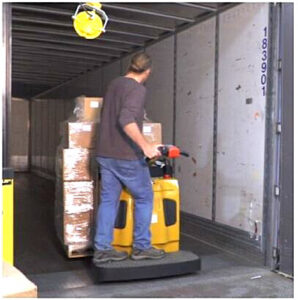 |
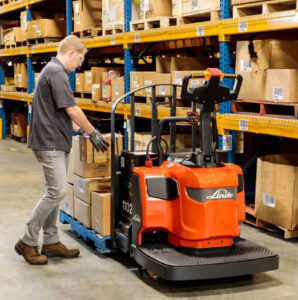
| Linde EWR Ride-On Pallet Truck | Big Joe RPL 44 Rider Pallet Truck |
Truck Spotlight:
The advantages of an end-controlled rider are showcased in the Linde EWR30 / EWR40 electric walkie/rider pallet trucks. Designed for demanding duty cycles, these trucks use 100% AC motor technology to support smooth performance in dock work, heavy-load transport, and order picking, while a large operator platform and ergonomic control handle with twist-grip controls help keep operation comfortable. The EWR series is available in 6,000- and 8,000-lb load capacities and offers travel speeds up to 5.5 mph with a load (up to 9.5 mph without a load), with options like electric power steering for added ease in busy workflows.
Linde’s steel pallet entry rollers and reinforced fork tips are designed to support smoother pallet entry, which can be especially helpful when working with worn or inconsistent pallets.
The Big Joe RPL44 is a compact, easy-to-maneuver rider pallet truck built for fast, efficient pallet moves in busy operations. With a 4,400 lb capacity and a 205Ah lithium-ion battery, it’s a strong fit for stop-and-go workflows like dock work, staging, and low-level picking—plus ergonomic controls and a comfortable operator platform help support productivity throughout the shift.
2. Center-Controlled Riders
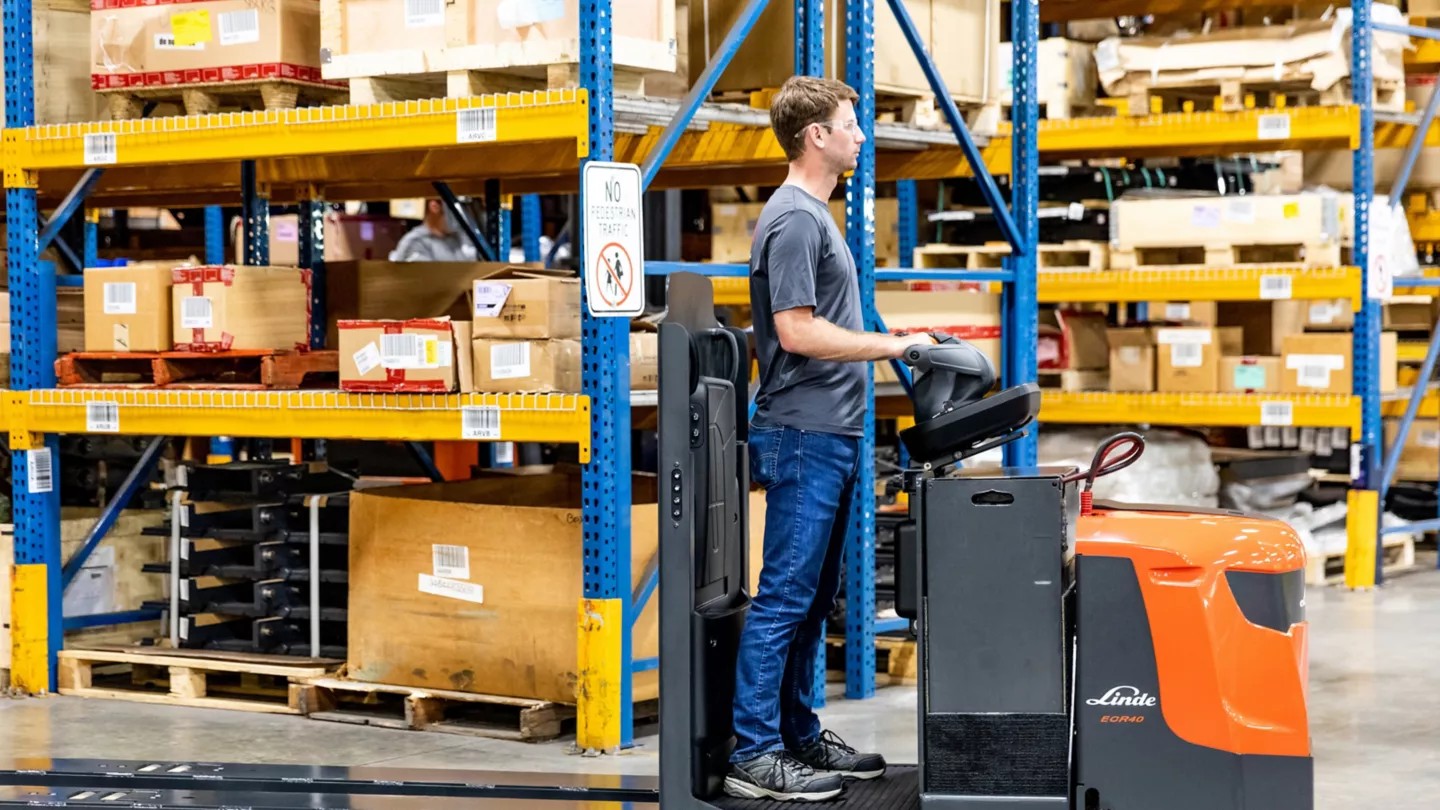
This type of rider has its operator compartment in the middle of the truck, between the forks and the motor. Center-controlled riders are generally longer than end-controlled trucks and thus are less useful in warehouse aisles, especially in narrow-aisle applications. They go the distance, however, and are designed to move pallets over more yardage than end-controlled units, often featuring a seat to accommodate the operator on long pallet journeys. They are ideal for large warehouses, distribution centers, and manufacturing facilities where pallets must be moved over long distances from storage to a dock or workstation. The center operator position offers greater stability, balancing the loaded forks against the motor and drive components. They offer the greatest value in applications where the truck is in motion most of the time rather than making frequent stops. However, their easy operator-compartment access still allows them to be used effectively for low-level picking.
Advantages:
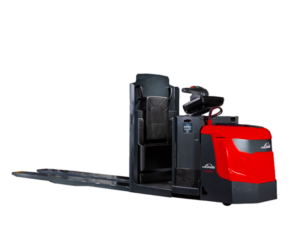
Linde ECR Pallet Truck
- Best for long runs
- Ideal for big facilities
- Greater operator comfort
- More stable ride
- Strong for high-throughput
Truck Spotlight:
A good choice for center-controlled riders in the Linde ECR Series, designed for long or short travel and low-level picking, and available in capacities of 6,000 or 8,000 lb. This rider pallet truck includes power steering for reduced operator fatigue, a low-step platform, and an easy-pick system with electronic coasting to allow operation on or off the truck. The ECR series can achieve a top speed of 7.5 mph loaded and 12.1 mph unloaded.
How to Choose the Right Rider Pallet Truck for Your Operation
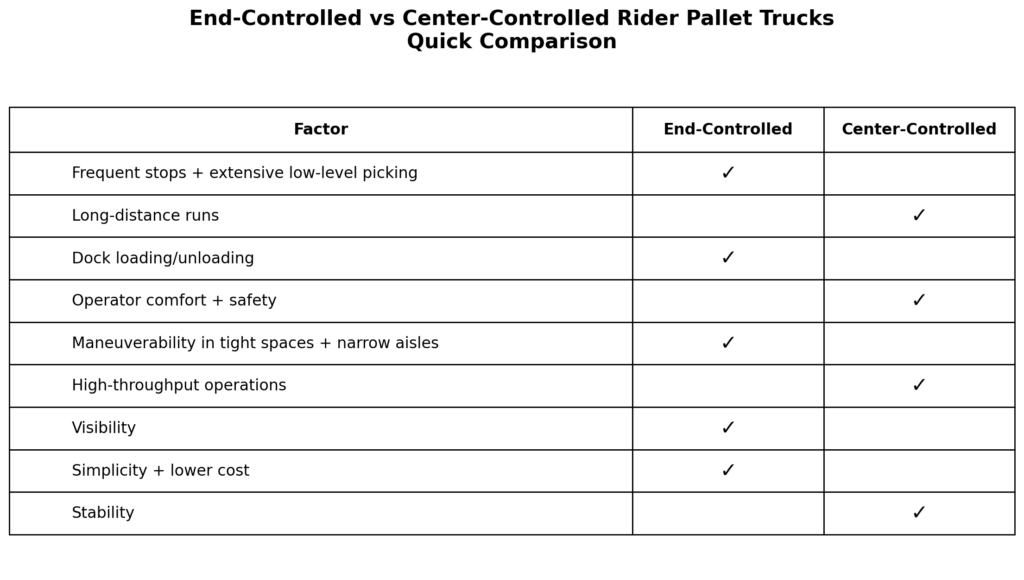
Here’s a short checklist of application-specific factors you should consider before taking the plunge:
Length of typical runs. (Short hops vs. long runs)
Frequency of stops. (How many picks per shift)
Frequency of dock loading, unloading, and cross-docking
Volume of pallets moved per shift. High vs. low throughput
Load size and weight. Double pallet moving?
Fork length requirements. Extended forks?
Operator visibility and comfort
Facility layout. Narrow aisles, heavy traffic, pedestrians.
Lease vs. buy vs. rent. Term of need
Battery strategy. Lead-acid vs. Li-ion
Rider Pallet Truck FAQs
1. What is a rider pallet truck?
A rider pallet truck is a powered pallet truck that lets the operator ride on the truck (instead of walking the whole time) while moving pallet loads. It’s commonly used for faster pallet transport, dock work, and low-level order picking, especially when travel distances are longer than is ideal for a standard walkie pallet jack.
2. What’s the difference between end-control and center-controlled rider pallet trucks?
End-control rider pallet trucks place the operator at the rear/end of the truck (often in a walk/ride setup), which can be ideal for frequent stops and mixed dock-to-floor tasks. Center-controlled trucks position the operator in a central compartment, which often feels more stable for longer transport runs and sustained low-level order picking.
3. Which rider pallet truck is better for long runs?
For long runs, a center-controlled rider pallet truck is typically the better choice because the operator rides in a more stable, comfortable position that’s designed for longer travel distances and higher-throughput transport.
4. Can rider pallet trucks be used for low-level order picking?
Yes. Rider pallet trucks are commonly used for low-level order picking, especially when operators need to travel longer distances between pick locations and want faster, less fatiguing pallet transport compared to walking behind a standard pallet jack.
5. What load capacities are common for rider pallet trucks?
Common load capacities for rider pallet trucks typically fall in the 4,000–8,000 lb range, with many models offered around 6,000–8,000 lb for warehouse transport on level floors.
6. What aisle width do I need for a rider pallet truck?
It depends on the exact model, your pallet/load length, and how the truck turns. The simplest way to estimate is: basic right-angle stacking width (right-angle stack/AST from the spec sheet) + load length + about 12 inches of clearance. Some manufacturer spec sheets also note adding roughly 6–8 inches of operating clearance.
7. Do operators need OSHA training for rider pallet trucks?
Yes. OSHA treats rider pallet trucks as powered industrial trucks, so employers must train operators, evaluate them in the workplace, and certify their competence (with performance evaluations at least once every 3 years).
Ready to Take The Next Step? Contact Apex.
Now that we’ve covered the pros and cons of both types of rider pallet trucks, your next best move is to contact the material handling experts at Apex and have them weigh in on your pallet-moving job and recommend the best truck for your application. We carry a full line of Linde, Clark, and Big Joe pallet movers.
Hey, money talks! We can also arrange financing for a purchase or a lease. If your need is short-term, talk to us about rentals.
Don’t forget the human side of things! OSHA requires that operators be trained on the specific type of equipment they will be using. Apex offers training for all types of forklifts.
Pay attention to the nuts and bolts! Apex can provide you with knowledgeable fleet maintenance and servicing, and spare parts.
You got this! Contact our team today.