
A Guide to Forklift Turning Radius and Its Impact on Warehouse Design & Safety
While a warehouse might not be a slalom ski course, today’s tightly packed warehouses demand forklifts that can navigate with precision. When selecting a new forklift, understanding its turning radius and right-angle stack capability is essential. The forklift turning radius dictates how sharply it can maneuver within narrow aisles, crucial for avoiding obstacles and optimizing space utilization. On the other hand, the right angle stack refers to how closely the forklift can approach storage racks perpendicular to the aisle, influencing efficiency in loading and unloading operations. These factors not only impact aisle design but also play a significant role in overall warehouse productivity. By considering these alongside power source, tire type, and storage requirements, you can ensure your new forklift meets both immediate operational needs and long-term efficiency goals.
Now, let’s delve deeper into mastering the right angle stack to understand its critical role in optimizing warehouse efficiency and operational flow.
Mastering the Right Angle Stack
A crucial aspect of forklift operation, particularly in relation to its turning radius, is the concept of the right-angle stack. This term refers to the minimum space required for a forklift to retrieve a load and turn 90° to transport the load down the aisle. Right-angle stack takes into account not only the forklift’s turning radius, but also the dimensions of the forklift. Essentially, it determines how much room the forklift needs to maneuver once it enters an aisle to load or unload pallets without obstruction. The right-angle stack is a dimension supplied by the manufacturer according to the forklift’s specs.
To calculate the minimum aisle width that a forklift can operate within, use the following formula:
Minimum Aisle Width = Right-Angle Stack + Load Length + 12 in.
The addition of the 12 in. is generally considered wise as the minimum amount that will allow the forklift to safely and efficiently load or unload palletized goods in the aisle.
Understanding these dimensions is crucial for optimizing aisle layout and ensuring efficient material handling.
Aisle Width & Forklift Turning Radius

CLARK Electric Counterbalance Forklifts
While forklift turning radius must always be considered when purchasing a forklift for a specific material handling job, it becomes a critical factor when the application is a densely packed, narrow-aisle warehouse. In these environments, a forklift’s ability to make sharp turns and navigate efficiently can significantly impact operational efficiency and space utilization.
Suppose your forklift application is an outdoor storage facility for stone products or a lumberyard. In that case, you have a lot of room to maneuver, and the turning radius is a less critical factor.
For warehouses or fulfillment centers containing many SKUs of consumer packaged goods (CPGs), you’ll want to opt for a forklift with a tight turning radius that allows your forklift operators to maneuver easily in the warehouse aisles.
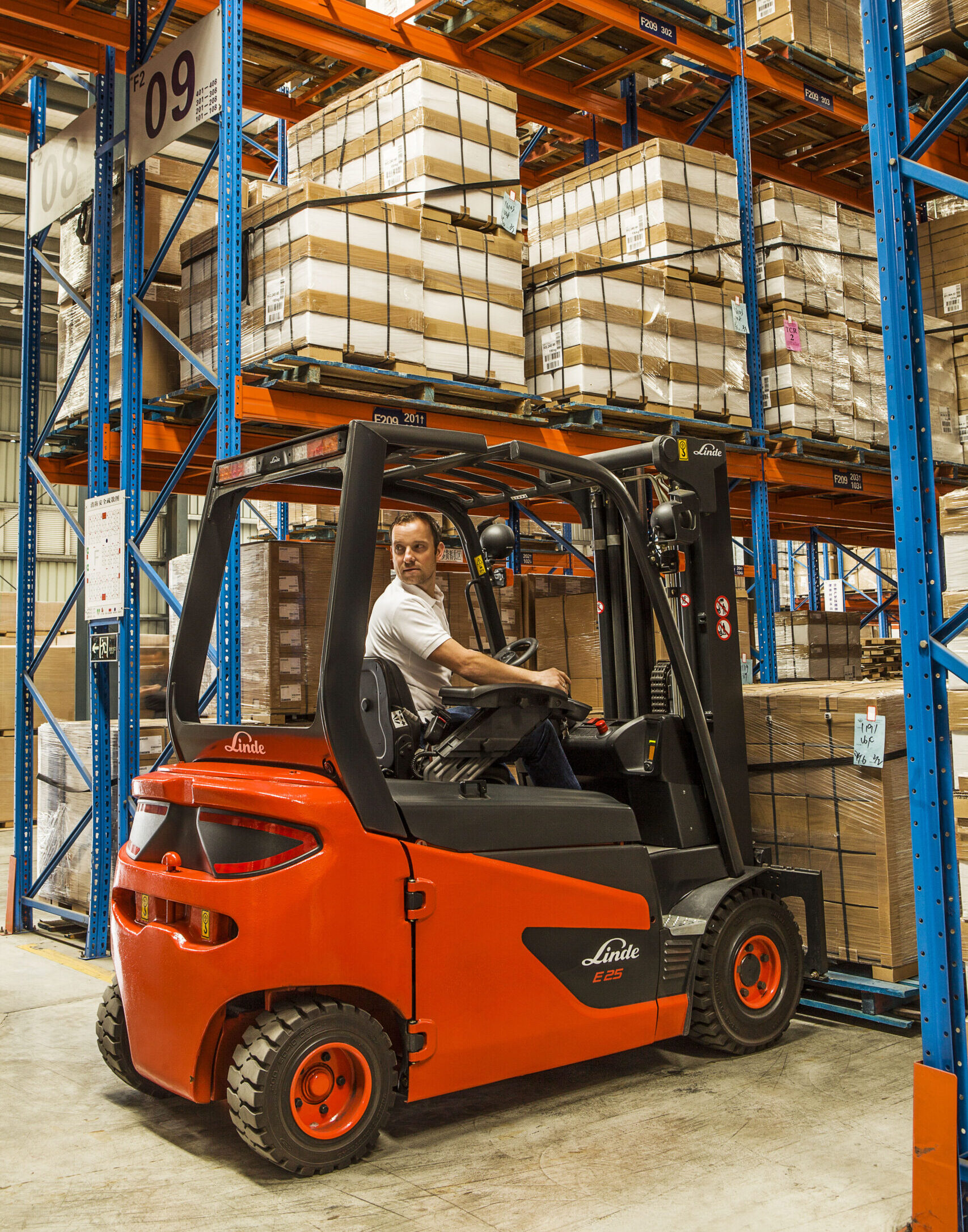
Wide Aisles – Ten Foot or MoreFor an outdoor yard application and most wide aisle indoor warehouses, you can safely use a four-wheel, internal-combustion or electric, pneumatic tire, counterbalance forklift. These forklifts are designed to lift and move heavy loads and generally require a wide aisle, such as 12 or 13 ft, to maneuver. Forklifts such as the Clark C 40/C45 series or the Linde E 25/E 30 series are designed for these types of applications. When your operations require tighter turns, such as in 10 ft. or 11 ft. aisles, a three-wheel, sit-down counterbalance forklift is likely your best choice. These rear-steering models offer turning radii ranging from 53 in. to 62 in. and right-angle stack dimensions of 67 in. to 80 in., allowing them to navigate narrow spaces effectively. However, it’s important to drive them carefully, as their sideways tipping risk increases if turns with loads are taken too quickly. The Clark SE 20T series is well-suited for such applications. For even tighter aisle widths, you may need a stand-up counterbalanced forklift. These compact counterbalanced forklifts have shortened body dimensions and feature turning radii of 51 to 60 in. and right-angle stack dimensions of 64 in. to 73 in. One good option is the Linde E18/E20. |
 |
Narrow Aisle – Nine Foot WideIf you really have a densely packed warehouse, let’s say with 8 ft. or 9 ft. aisles, you’ll need to go with a reach truck. These compact workhorses have right-angle stack dimensions in the range of 46 in. to 58 in. Your choices here include the Clark NPX20/22 Series or the Linde R15SX/R17SX |
 |
Very Narrow Aisle – Less Than Nine Foot WideIn extremely narrow aisles, say 7 ft. or less, your only option is a swing-mast or turret truck, for these innovative forklifts, right-angle stack, and turning radius are moot points since they feature sideways pallet loading. The Clark ECX30 or Linde A Series turret trucks are the ideal solution for these applications. |
Turn Radius & Forklift Center of Gravity
Regardless of your forklift’s turning radius or right-angle stack dimension, exercising caution during turns and travel is crucial, especially when the forklift is loaded. When carrying a load, the forklift’s center of gravity shifts forward, significantly increasing its instability. This effect is particularly pronounced with three-wheel forklifts due to their design.
Key Considerations:
- Impact of Center of Gravity Shift: The forward shift in the center of gravity reduces stability and increases the risk of tipping during turns, especially in narrow or congested aisles. Operators must be mindful of load weight and distribution to maintain control.
- Challenges with Three-Wheel Forklifts: While maneuverable, three-wheel forklifts are more susceptible to instability when turning with loads. Their single rear wheel and lighter front-end design require operators to approach turns with heightened caution to prevent accidents.
- Practical Tips for Safe Turning:
- Always assess the turn radius and aisle width before maneuvering, ensuring there’s sufficient space to complete the turn safely.
- Reduce speed before entering turns, allowing for better control and stability.
- Maintain a lower center of gravity by keeping loads as close to the ground as possible, especially in elevated positions or on uneven surfaces.
- Training and Awareness: Comprehensive operator training is essential. It should cover the effects of load handling on forklift stability, proper turning techniques, and situational awareness to anticipate and avoid potential hazards.
Let’s take a closer look at that last consideration… forklift operator training.
The Right Turns for Forklift Operator Training & Safety

Forklift Operator Training & Certification
Regular, comprehensive training is essential for all forklift operators to reinforce safe operating practices. Training sessions should cover a range of topics, from load-handling techniques to recognizing and avoiding potential hazards. This ongoing education not only enhances operator skills but also fosters a safety-conscious culture within the workplace. By remaining vigilant and continuously updating skills, operators can effectively mitigate risks and contribute to a safer working environment for everyone.
6 Tips for Safe Forklift Maneuvering
- Keep forks at a proper travel height: Maintaining the correct fork height ensures stability and improves visibility. Adjust fork heights based on load size and aisle clearance to prevent damage to overhead fixtures and maintain balance during travel.
- Maneuvering around columns and bollards, or entering and exiting dock areas and trailers: Exercise unique caution in these areas to avoid collisions and damage to both the forklift and surrounding structures.
- Mind uneven surfaces and reduce speed on turns, especially with three-wheel forklifts: Uneven surfaces pose challenges and require reduced speed to maintain control and prevent accidents. Never turn a loaded forklift on an incline to avoid tipping.
- Reduce speed in tight areas or when approaching intersections: Slowing down in congested areas or intersections enhances control and responsiveness, which is crucial for navigating safely amidst pedestrian traffic or other equipment movements.
- Use spotters if visibility is limited: Spotters are essential for guiding forklift operators in blind spots or obstructed areas. Clear communication with spotters ensures safe navigation around obstacles and overall site safety.
- Perfect practice makes perfect: The narrower the aisle the higher the risk. If you’re switching to a Narrow Aisle or Very Narrow Aisle, it’s worth considering practicing turning in your warehouse using floor tape, cones, and a simple rack setup.
Apex offers on-site group training incorporating classroom and practical instruction using your equipment to ensure your operators are proficient and comfortable in your warehouse setting. We also offer individual certification and recertification classes at our Smoke Tree location —book online!
OSHA Requirements & Best Practices
OSHA mandates specific training and certification for forklift operators to ensure they possess the necessary skills and knowledge for safe operation. This includes understanding load capacities, maneuvering techniques, and emergency procedures. Compliance with these guidelines enhances workplace safety and helps avoid regulatory penalties.
Forklift inspections and regular maintenance are critical to identifying potential mechanical issues or safety hazards before they escalate. Operators should perform pre-shift inspections and adhere to manufacturer-recommended maintenance schedules to keep forklifts in optimal working condition. Safety checklists should cover essential components such as brakes, steering, tires, and lights, ensuring that each forklift is safe and ready for operation.
Smart Warehouse Design Improves Forklift Efficiency and Safety
When designing a warehouse layout, careful consideration of product movement, aisle width, equipment placement, and the integration of designated lanes for forklifts and pedestrians is crucial. By optimizing these factors, warehouses can enhance both forklift efficiency and safety. Paying attention to forklift turning radii ensures smooth and safe navigation throughout the facility.
 Benefits of Smart Warehouse Design:
- Efficiency Boost: Well-planned layouts minimize travel times, reduce congestion, and streamline operations, leading to increased productivity.
- Enhanced Safety: Thoughtful design improves visibility, reduces the risk of accidents, and promotes a safer working environment for all warehouse personnel.
Apex: Your Comprehensive Warehouse Solutions Provider
As your full-service partner in warehouse and material handling solutions, Apex offers expertise in warehouse layout and design, material flow consulting, forklift supply, spare parts, maintenance, repair, and fleet management. Contact the Apex team today to optimize your warehouse for maximum efficiency and safety.