
What is a Turret Truck?
As aisles become increasingly narrow to maximize storage capacity in warehouses and distribution centers, businesses face the challenge of equipping their teams with the right equipment. Turret trucks emerge as the most effective solution for navigating these tight spaces.
The unique configuration of the forks and operator compartment allows a pivot and rotation of 180 degrees to access racking on either side of the narrow aisle for loading or extracting pallets or cases. This exceptional maneuverability boosts loading and unloading accuracy, efficiency, and safety, making turret trucks an invaluable asset.
WHICH CHALLENGES MUST YOU OVERCOME?
While considering which type of turret truck (also known as a VNA forklift) to purchase, you’ll likely encounter one challenge—the choices are virtually endless. New models are released regularly, and new features are created quickly and steadily, with technology advancing nearly every day.
From manual to semi-automated to fully automated turret trucks, you may wonder which option is ideal for your facility and your specific application needs.
To help ease the selection process, here is some information you should know before you purchase your next turret truck—one that will meet your storage and order fulfillment needs and, in turn, increase your efficiency, safety, space utilization, and speed.
MANUAL TURRET TRUCK OPERATION

Sometimes, the familiar way is still the best. This is especially the case if you’re interested in increasing or maintaining your workforce. Manual turret trucks allow you to conduct several picking tasks while relying on your skilled human talent.
During a manual turret truck operation, the following will generally occur within a narrow aisle, or very narrow aisle, pallet rack system.
- P&D Picking and Replenishment: An operator using a manual forklift —not a turret truck—will first drop off (or pick up) pallets from pick and deposit (P&D) stations located at the end of the storage rack row. Since palletized material is often stored or distributed elsewhere, the pallets are temporarily deposited until they can be placed, either in the VNA rack, or another location within the warehouse.
- Changing Aisles: The turret truck operator will drive from one lane to another as needed to access all pick locations across various aisles.
- Operating Within Aisles: The manual turret truck driver will drive to the right pallet location with the assistance of either a floor-embedded wire guidance system or a floor angle down both sides of the aisle.
- Lifting to a Pallet’s Location: Once the driver arrives at the exact pallet location, they will load or pick the inventory, raising the truck mast as needed.
- Pick or Put Away from a Pallet’s Location: The driver will then complete the pick/putaway activity.
- Traveling Back to a P&D Station: Once they’ve completed the activity, the operator will drive back to a P&D station to continue the process.
Optional Features*:
Blue Spot: The Blue Spot feature projects a blue light on the floor to alert personnel of an approaching automated forklift, enhancing safety in busy environments. This visual indicator increases awareness and helps prevent accidents by signaling the presence and movement of equipment.
Telescopic Forks: Telescopic forks on automated forklifts allow for extended reach and adaptability when handling various load sizes and shapes. This versatility enhances operational efficiency by enabling easy access to high racks and tight spaces while also providing improved stability when lifting heavy or awkwardly shaped loads.
*available in all vehicles – manual to automated
ADVANTAGES OF MANUAL TURRET TRUCKS
While manual turret truck operation requires trained, certified, and skilled operators, there are serveral advantages of these vehicles vs. their automated counterparts. These advantages include:
Cost-Efficiency: Manual turret trucks are generally less expensive than their semi- or automated counterparts, making them a more budget-friendly option for operations where automation isn’t necessary.
Simplicity: They are straightforward to operate and maintain, with fewer complex components compared to automated models. This simplicity can lead to lower maintenance costs and easier training for operators.
Enhanced Operator Awareness: Manual operation keeps the operator more engaged with the surroundings and load handling, potentially improving safety and accuracy in certain scenarios.
Overall, while manual turret trucks may not offer the enhancements of automated lift trucks, they remain a practical and cost-effective solution for specific warehouse needs.
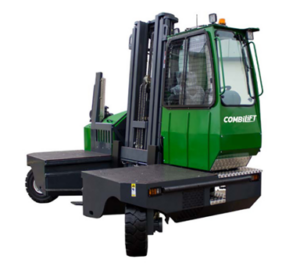
Combi SL9000 Sideloader Forklift
Muti-Function/Combination Manual VNA Vehicles
Versatility arrives in a unique package with multi-function trucks which are designed to maximize productivity in tight spaces. These versatile vehicles offer advanced capabilities for various material handling tasks, ensuring both flexibility and safety in diverse operational environments.
Counterbalance forklift and side-loader equipment: This design enables operation in aisles as narrow as 5 feet 6 inches while lifting loads up to 49 feet high. Wire guidance control is an option. These vehicles also operate indoors and outdoors, expanding their functionality.
Sit-down counterbalance forklift with a turret head: This configuration enables precise maneuvering and load handling in very narrow aisle (VNA) applications. This versatile vehicle can be retrofitted onto existing trucks, allowing the operators to access palletized loads in tight spaces while providing enhanced stability and safety. It is designed primarily for low-speed maneuvering, making it a more cautious option for navigating very narrow aisles vs. rapid throughput.
SEMI-AUTOMATED TURRET TRUCK OPERATION

To streamline operations and increase output, many facilities are upgrading to semi-automated turret trucks. Semi-automated turret trucks combine manual control with automated features. The level of automation you apply to your vehicle can vary widely.
A Look at Semi-Automated Operation from the Driver’s Seat
Here’s a look at how semi-automated turret trucks may differ from manual vehicles in warehouse applications:
- P&D Pick and Replenishment: Much like a manual turret truck operation, during a semi-automated process, a standard forklift operator drops or picks up pallets from the designated locations at the end of a row.
- Changing Aisles: The semi-automated turret truck operator will drive the vehicle from aisle to aisle.
- Operating Within Aisles: This is where a key difference between manual and semi-automated trucks comes into play. Once the turret truck is in the aisle, it is automatically guided to the bay location.
- Lifting to a Pallet’s Location: The turret truck will automatically lift to whichever pick level is necessary.
- Pick or Put Away from a Pallet’s Location: At this point, the operator conducts the pick or put away processes at the pallet’s location.
- Traveling Back to a P&D Station: Afterwards, the turret truck automatically proceeds to the P&D station to drop off or pick up the next pallet.
Optional Features:
Guidance systems: Wire guidance embedded in the floor or vehicle-equipped laser guides (see navigation below for details).
Speed control: End-of-aisle control automatically slows vehicle speed at the openings to the aisle while maximizing speed in between. Magnetized options include a complete stop near the aisle ends with a slow (“creep”) speed to reach the very end.

Lift Height Preselection: Allows different rack heights to be entered into the system’s memory so that the driver then only needs to enter the rack destination.
Automatic Fork Cyclus: Facilitates automated execution of multiple movements during pallet placement or retrieval, enabling the truck to raise or lower the forks while simultaneously controlling the main and auxiliary lifts. This capability streamlines the handling process, significantly improving speed and accuracy.
Additional Semi-Automated Options:
- Dynamic Reach Control: Turret trucks can feature dynamic reach control systems that allow operators to maneuver loads with precision. This technology enables the forks to extend and retract smoothly, facilitating efficient access to high-rack storage while maintaining stability.
- Navigation Laser: Trucks can detect their surroundings and navigate effectively without the need for additional guiding infrastructure. This allows for seamless movement in tight aisles and reduces the risk of collisions.
- Optimized Travel Paths: Navigation systems can calculate and optimize travel paths to efficiently move between picking locations with minimal downtime. This results in increased productivity and faster cycle times in high-density storage environments.
Advanced Semi-Automation

Linde K-Matic
Linde semi-automated turret trucks use a navigation system called Telegram Exchange to communicate with the WMS. This system ensures precise navigation through narrow aisles by transmitting real-time data between the truck and the warehouse system. The system calculates the most efficient route and optimizes truck movements for accurate pallet placement or retrieval. The use of RFID tags or barcodes embedded along the aisles helps guide the truck to its exact location, minimizing operator error and increasing productivity.
The Telegram Exchange facilitates smooth communication, allowing for efficient task allocation and coordination between multiple trucks in automated fleets.
RFID technology: Precision navigation and assistance in location tracking, optimizing routes, obstacle detection, and real-time data feedback for better warehouse efficiency.
Bar code reader: Facilitates accurate inventory identification, streamlines product scanning, verifies item locations, reduces manual input errors, and ensures quick and efficient picking or goods storage.
Advanced operator panel: Offers real-time navigation and system feedback, automated task assistance, safety alerts, and customizable settings to enhance operational efficiency, safety, and ease of use.
ADVANTAGES OF SEMI-AUTOMATED TURRET TRUCKS
Implementing semi-automated turret trucks reduces the number of operators, freeing skilled workers for other valuable tasks. The automated features minimize human error and costs, improve order-picking accuracy, and significantly increase picking speed by streamlining processes and enabling a single unit to perform multiple tasks efficiently.
Increased Efficiency: Semi-automated turret trucks automate repetitive tasks such as lifting and positioning, which speeds up loading and picking processes while allowing the operator to focus on more complex tasks.
Improved Accuracy: Automation helps reduce human error, leading to more precise positioning of pallets and cases. This accuracy is crucial in narrow aisles where space is limited, and mistakes can be costly.
Enhanced Productivity: By automating certain functions, semi-automated turret trucks allow operators to work faster and handle more inventory in the same amount of time compared to fully manual models.
Safety Improvements: Automated systems often include safety features such as collision avoidance and improved load stability, which can reduce the risk of accidents and improve overall warehouse safety. They also contain sn emergency stop feature to halt the vehicle in case of an emergency immediately.
Flexibility: Semi-automated models often allow operators to switch between manual and automated modes, providing flexibility to handle a variety of tasks and adapt to changing operational needs.
Overall, semi-automated turret trucks offer a balance between the control of manual operation and the efficiency of automation, making them well-suited for complex and high-density warehouse environments.
AUTOMATED TURRET TRUCK OPERATION
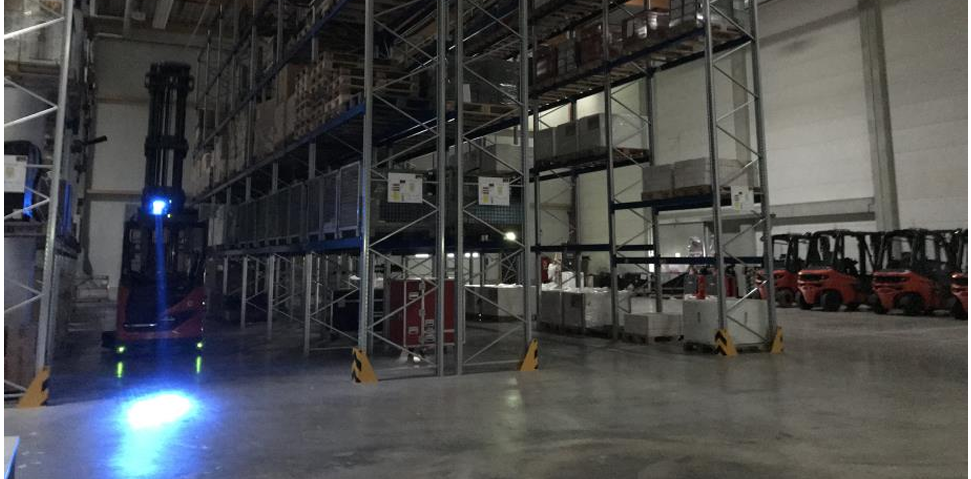
Linde Autonomous VNA Turret Truck – with Blue Spot Feature
As the demands for larger orders and quicker deliveries continue to increase during the e-commerce era, the likelihood of full automation integration is rising in DCs and warehouses across the world. This integration will likely involve turret trucks as well.
Although automated turret truck operation eliminates the need for operators for those specific functions, DCs and warehouses will still be able to utilize skilled workers for other value-added activities.
-
- P&D Pick and Replenishment: During a fully automated turret truck operation, an AGV will transport a pallet from a staging location to a P&D station once it’s been scanned and a contour check has been completed.
- Changing Aisles: Additionally, a turret truck will automatically change from one aisle to another without requiring any manual assistance.
- Operating Within Aisles: The turret truck will automatically drive to the bay as well, as is the case with a semi-automated operation.
- Lifting to a Pallet’s Location: Likewise, the truck will also automatically lift to whichever pick level is required.
- Pick or Put Away from a Pallet’s Location: All picking will be automatically conducted by the turret truck, thereby eliminating any need for manual labor.
- Traveling Back to a P&D Station: Vehicle will automatically drive back to a P&D station, leading to a fully automated process.
- Conveyor interface: Seamlessly load and unload goods, significantly reducing manual labor and minimizing the risk of errors during transfer processes.
Optional Features:
Linde 3D Pallet Recognition: K-Matic automated forklifts feature an inbound pallet contour control and verification feature that enhances its operational efficiency by enabling accurate identification and handling of pallets. This 3D pallet recognition technology recognizes the dimensions and positioning of incoming pallets and verifies that they are correctly placed before executing any handling tasks.
Automatic Charging: Automated forklifts equipped with automatic charging systems can autonomously dock with charging stations when battery levels are low, ensuring minimal downtime and maximum operational efficiency. This feature not only saves time but also reduces labor costs associated with manual charging and battery maintenance.
ADVANTAGES OF AUTOMATED TURRET TRUCKS
 While semi-automated turret trucks offer notable efficiency, safety, and speed, fully automated systems take these benefits to an even higher level. By eliminating the need for human operators, fully automated turret trucks reduce the risk of injuries and ensure continuous operation 24/7. This uninterrupted productivity boosts picking speed and accuracy, potentially enhancing profit margins and allowing for more effective responses to customer demands.
Maximized Efficiency: Fully automated turret trucks can operate continuously without breaks, maximizing throughput and optimizing warehouse operations. They handle repetitive tasks with precision and speed, reducing the time required for each cycle.
Enhanced Accuracy: Automated systems eliminate human error, ensuring consistent and precise placement and retrieval of inventory. This accuracy is crucial in narrow aisles where space is limited and the margin for error is minimal.
Increased Productivity: By automating the entire process, these trucks can perform tasks faster than manual or semi-automated models, leading to higher overall productivity and the ability to handle more inventory within the same timeframe.
Reduced Labor Costs: Automation reduces the need for manual labor, leading to lower labor costs and allowing human resources to be allocated to more strategic or complex tasks within the warehouse.
Improved Safety: Fully automated systems minimize human intervention, reducing the risk of accidents and injuries associated with manual handling and machine operation in tight spaces.
Consistency in Operations: Automated turret trucks provide consistent performance, maintaining high standards of operation and reducing variability in handling and inventory management.
Overall, fully automated turret trucks enhance efficiency, accuracy, and safety in narrow aisle environments, making them a valuable investment for warehouses and distribution centers aiming to optimize their operations.
ENHANCE YOUR PRODUCTIVITY WITH TURRET TRUCKS

Each type of turret truck offers positives. Manual vehicles maintain your workforce while simultaneously experiencing the benefits of narrow aisle and VNA warehouse design.
On the other hand, semi- or fully-automated turret trucks will exponentially improve your efficiency, safety, and throughput speeds while allowing you to allocate skilled workers to value-added tasks to further improve customer service and support.
We get it—navigating the complexities of VNA (very narrow aisle) setups can be challenging. Let the Apex team take it from here! To get started, we need a few things from you:
- A drawing or AutoCAD file of your current layout
- Timing for an Apex Pro to visit your facility, if possible
- Insights into your current operations or your goals for the next 5 to 10 years
- Additional details such as pallets in/out, budget, and timeline
Contact us today, and let’s enhance your warehouse efficiency together!