Here Are Some Considerations for Successful Forklift Leasing
You’ve gone through the financial analysis and have decided to lease rather than buy your new forklifts. Hopefully, our lease vs. buy blog has helped you with that decision. Now you’re faced with the next step in forklift leasing: choosing the right type of lease.
Which Type of Lease Is Best For My Business?
There are several forklift leasing options, which depend on the nature of your business and the length of time you will need the forklift. Before deciding on a lease, you should also review the options with your tax professional. Let’s look at the options:
Operating Lease
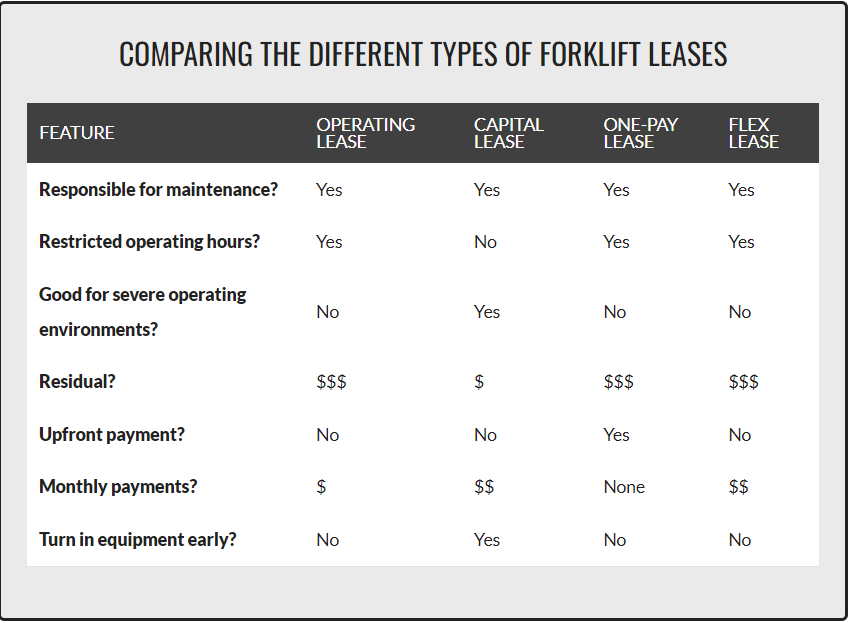
Also known as a fair-market-value (FMV) lease, this is the simplest, most common, and least expensive lease–almost like a long-term rental. You determine the number of months you need the forklift and pay a monthly lease fee. Depending on the terms of the lease, you may or may not have to put down an initial payment. That can often be negotiated. This type of lease also prescribes a set number of hours of usage and can involve a penalty if that limit is exceeded–just like a car lease. At the end of the lease, you have the choice to buy it, continue to lease it on a month-to-month basis, or turn it in and walk away. Like an automotive lease, you and the lessor agree on the initial price and the forklift’s residual value at the lease’s end. The lease is an off-balance sheet expense, which means it doesn’t affect your company’s capital position and is treated as a simple monthly operating expense.
Capital Lease
A capital lease is designed for companies that have already decided to buy the forklift at the end of the lease but don’t want the responsibility of ownership during the lease term. This lease is primarily used for forklifts that will see extensive usage by the lessee. There is no limit to the number of hours in service or restrictions on using the forklift in severe environments. Monthly costs for a capital lease are higher than those of an operating lease, and the residual value of the forklift at the end of the lease is much lower. Some leases are set up so that the buyout value is $1.00. Capital leases are reported on a company’s balance sheet and can offer some tax benefits.
One-pay Lease
Also known as a “prepaid lease,” this type of lease is best for companies that are in a good cash position at the start of the lease, either because of seasonal income or other cash windfalls. A one-pay lease is also good for companies with problems getting credit. You basically pay up-front for the whole lease, thus having better cash flow at potentially leaner times of the year. You’ll pay a lower tax rate and drastically reduce your interest payments. Savings also accrue from not having the administrative cost of processing monthly payments. Like an operating lease, there’s a limit to the forklift’s hours of usage, and at the end of the lease, you have the same options of buying the forklift or turning it in.
Flex Lease
A flex lease is similar to a standard operating lease except that it comes with specific opt-out points. If you no longer need the forklift after a specific time, you can terminate the lease. Or, you can negotiate the remainder of the lease at a lower rate. The monthly payments for the initial period will be higher than those of an operating lease. This type of lease is suitable for companies with client contracts that may terminate before the end of the lease. You still have the option at the end of the lease to buy the forklift or turn it back in.

What About Maintenance?
Generally, you (the lessee) are responsible for maintaining the forklift. If you want to take the burden of maintenance off of your in-house staff, you can add a maintenance contract to your lease. This works perfectly if the forklift dealer finances your lease because they have an experienced maintenance staff that knows the equipment. If you set up your lease through a financial institution, you’ll have to buy a separate maintenance plan or have your in-house staff maintain the vehicle.
Who Finances Lease Arrangements?
You have several options here.
- Banks. If you have a good relationship with your banker, they can arrange a lease deal on favorable terms.
- Lease brokers. These companies can help you find financial institutions that fit your company’s financial situation. Expect to pay a commission fee of 1 to 5%
- Independent leasing companies. These firms have lots of experience setting up leasing arrangements and can be a good source for understanding the different types of leases. Many of them offer contracted maintenance plans to help you keep your equipment in good shape.
- Captive leasing companies. Many forklift dealers offer their own financing or financing provided by forklift manufacturers. Apex Financial Services can help you set up a cost-effective forklift leasing program as well as a maintenance plan.
How are Lease Duration and Costs Calculated?
As the lessee, and the entity that’s going to be using the forklift, you determine the length of the lease. If you are using your new forklift 24/7 or your environmental conditions are extreme, you’ll probably want to opt for a shorter-term lease. Leases are generally written from 12 to 72 months, with the bulk written for 36 to 60 months.
Monthly lease costs are calculated based on the following:
- The negotiated purchase price of the forklift
- The interest rate (and that’s been climbing recently)
- The length of the lease
- The total number of hours the forklift will be used during the lease
- The forklift’s operating environment
For example, a rough estimate of forklift leasing is $20 to $25 per month for each $1,000 financed. Thus, a $25,000 forklift will cost $400 to $500 per month for a standard operating lease or $800 to $1,000 for a $40,000 forklift. Note: this is a very general yardstick.

Other Forklift Leasing Considerations
- Delivery and Return. Will the leasing company deliver the forklift to your location, or do you have to pay to have it shipped? Likewise, will they pick it up when you return it, or do you have to pay to return it to some warehouse five states away?
- Insurance. What insurance documentation do I need to provide to the leasing company? Does my existing insurance cover leased equipment? If your insurance changes, be sure to notify your leasing company.
- How are Service Hours Calculated? If your usage of the forklift will vary widely throughout the lease, it’s a good idea to have hours of service calculated once at the end of the lease rather than on an annual basis. This avoids overuse penalties.
- Can I End My Operating Lease Early? Stuff happens –Plan for it by having an understanding with your lessor about what happens if you don’t need the forklift partway through your lease.
- Opt for a Closed-end Lease. Some leasing arrangements involve a balloon payment at the termination of the lease. Avoid these, if possible.
- Forklift Condition At the End of the Lease. It’s a good idea to have an understanding with the leasing company about what sort of wear and tear can be expected at the termination of the lease.
- Consider Renting as an Option. If there are uncertainties about how long you will need the forklift, a short- or long-term rental may better suit you. Generally, you can just give back the equipment when you no longer need it.
Forklift leasing is a very attractive alternative to purchasing and can offer your company a lot of flexibility in its material handling capabilities. Apex Financial Services should definitely be on the top of your list as a source for both the equipment you need and the financing to afford it. Also, remember Apex when your looking to add new pallet racking systems to your warehouse —we offer attractive leasing agreements that help you stretch your capital expenditure dollars.
Working with a local, knowledgeable material handling dealer can simplify the leasing process and offer you a quick turnaround on maintenance. In the Chicagoland area, Apex is your go-to supplier for all things related to material handling and warehouse management.