Learn How to Right-Size Your Forklift Forks & Select The Right Extensions
If you’re moving the same standard 48-in. pallets day in and day out, you probably don’t need to concern yourself with forklift fork length; your OEM 42-in. forks will work just fine. But once you move out of that comfort zone, say your distribution center starts handling import pallets or even non-palletized loads, you need to pay attention to forklift length.
Sizing Up Forklift Forks
Too Long
Forks that are too long for the load you are transporting present several safety hazards. Forks sticking out beyond the load can accidentally damage pallet racking or products while loading or unloading. More significantly, they also pose the risk of striking a pedestrian. While turning a forklift, the operator may not have visibility of the front end of the forks, potentially causing the forks to crash into objects or people, particularly in a narrow aisle setting.
Too Short
While sometimes shorter is better, using a fork that’s too short can cause instability in the load and potentially allow a loaded pallet to tip over, damaging product and posing a hazard to pedestrians or the forklift operator. Trying to extract a pallet from a high rack with forks that are too short can spell disaster.
Just Right
Your forklift’s forks should reach at least ⅔ of the way into your load but not exceed 100% of the load’s length. For example, a 48-in. pallet/42-in. fork ratio is ideal.
What if My Forks Are Insufficiently Sized?
One option is to replace the forklift forks; however, it is a tricky and potentially dangerous process as forks can weigh upwards of 250 lb. Note it is also time-consuming.
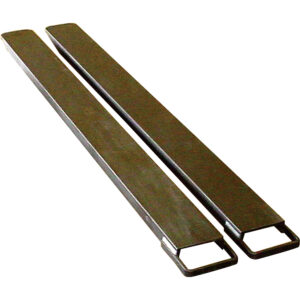
Forklift extensions are a potentially better solution. If you work in a warehouse where the length of the forks on your forklift need to change regularly, forklift extensions can make your life easier and safer.
Forklift extensions come in two types–mechanical and hydraulic.
- Mechanical forklift extensions: the operator manually installs and adjusts the fork extension to match the length of the load
- Hydraulic forklift extensions: controllable from the operator’s compartment.
Use forklift extensions with care, however. Forklift extensions should never exceed 50% of the forklift’s original length since their use moves the load’s center of gravity further forward, reducing the vehicle’s lifting capacity and increasing the likelihood of a tip-over. Forklift extensions are also only designed for occasional use. If you require extensions regularly, replace the forks with longer ones.

Forklift Fork Extensions
Don’t Improvise
Don’t try to take shortcuts and use standard forklift forks to move a non-standard load that requires a special attachment. Consult our blog, Multiply Your Forklift’s Capabilities With Forklift Attachments, to help you select the correct attachment for non-standard or non-palletized loads.
Always Be Aware of Your Load Center
Most forklifts are designed so that the load center of gravity is 24 in. from the face of the forks. That is the distance at which the forklift’s lifting capacity is rated. Using a fork extension or installing a longer fork to carry a longer load pushes the load’s center of gravity further forward, and thus reduces the forklift’s rated lifting capacity. In that case, it’s a good idea to contact the forklift manufacturer to have them provide you with a letter authorizing the use of the forklift with longer forks and indicating the new rated capacity. The manufacturer may also have a chart that indicates how the rated capacity of the forklift decreases as the length of the forks and the length of the load increases.
Inspect Forks and Extensions for Wear and Damage
As the business end of a forklift, forks take the brunt of the stress of moving loads. They do get damaged, and they do wear out. Both forks and extensions require regular examination and replacement as needed –A fork that has lost 10% of its thickness through wear experiences a 20% reduction in lifting capacity.
Training, Training, Training!
Once again, comprehensive and consistent training is the key to efficient and safe forklift operation. If your facility is planning to use forklift extensions, make sure the operators of forklifts outfitted with these extensions have had thorough training sessions on how to correctly install them, inspect them before and during a shift, and use them properly and safely. Contact Apex–we can set up training for using forklifts with fork extensions.
Apex offers a wide range of forklift attachments, including forklift extensions. Talk to your Apex rep about your material handling needs and we can provide you with the safe, efficient extension or attachment that is right for your task at hand. And don’t forget training. Apex offers comprehensive on-site group operator training for your material handling equipment. Apex is your material handling expert in the Chicagoland area.