
Hydrogen Fuel Cells are Environmentally Friendly and Energy Efficient, But…
Are they the right forklift power source for your forklift fleet?
During the oil shocks of the 1970s, several alternative energy sources received heightened attention; one of them was the hydrogen fuel cell.
Over the years, hydrogen fuel technology has continued to evolve. Although it is deemed too costly to create an infrastructure to power passenger cars and commercial vehicles, it has become, to some degree, a viable alternative for powering forklifts, where a company could build its own infrastructure.
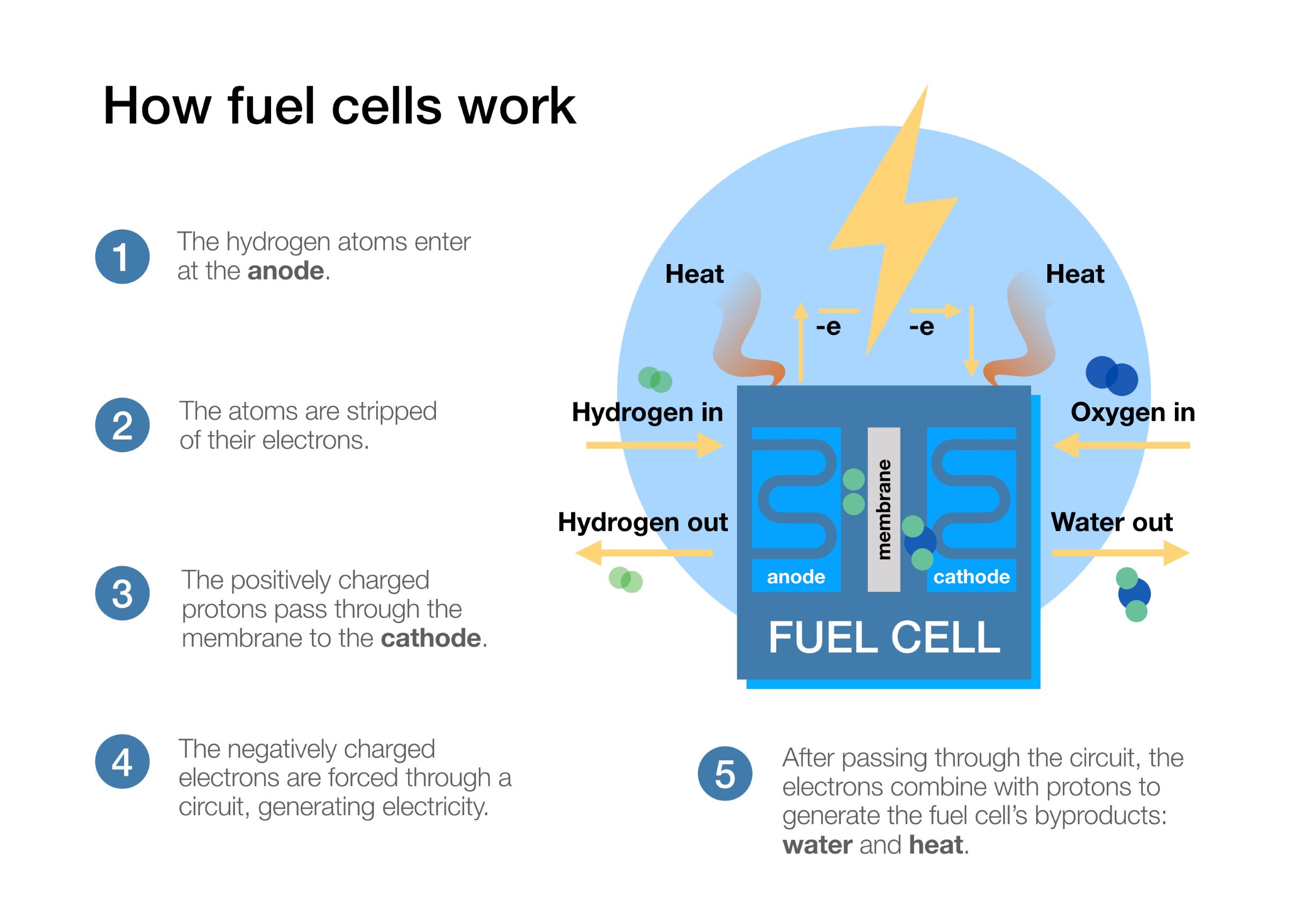
A fuel cell is very similar to a battery in the sense that there is an anode, a cathode, and an electrolyte that facilitates the movement of ions through a membrane known as a proton exchange membrane. Hydrogen is introduced on one side of the cell, and oxygen on the other. Positively charged hydrogen ions permeate the membrane, combining oxygen to form water as a by-product. The residual electrons provide the electric power flow.
Fuel Cells vs. Internal Combustion Forklifts
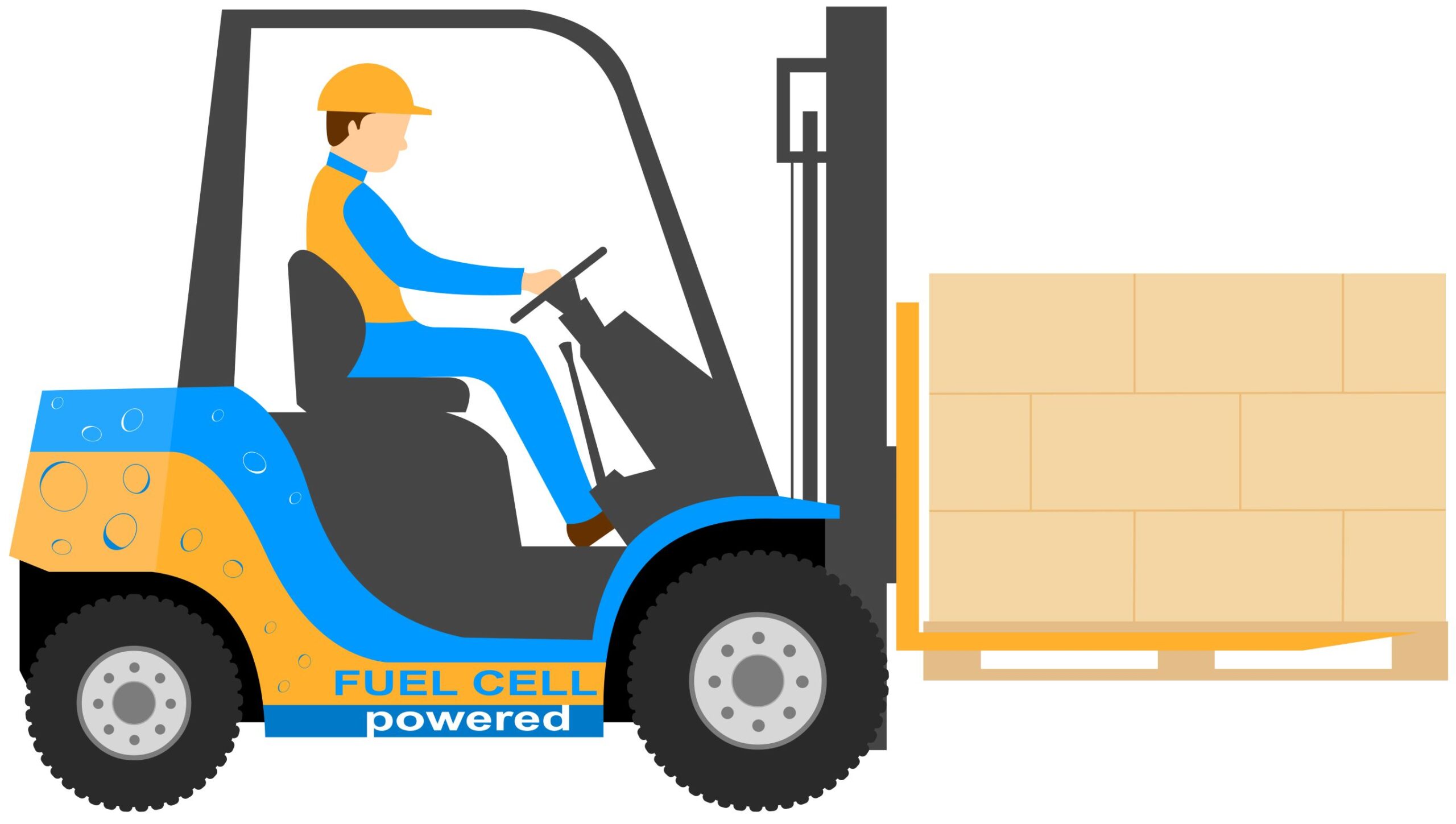
Fuel cells are relatively simple devices with no moving parts. Their only byproduct is water. Compared to traditional internal combustion (IC) forklifts, fuel cells are much more environmentally friendly, producing no emissions, and don’t require maintenance like complicated IC engines. No oil changes. No filter changes. No ignition system upkeep. Like IC forklifts, they can be refueled in a matter of minutes. Hydrogen has a higher energy density than natural gas, allowing a fuel cell forklift to operate for an extended time after a recharge vs. IC forklifts. Thus, they have an advantage in productivity.
Fuel Cells vs. Lead-Acid Battery
Compared to lead-acid battery electric forklifts, hydrogen fuel cell forklifts dispense with the mega-weight battery and the need to swap it out once it runs out. Fuel cells maintain their power levels throughout the time used, unlike lead-acid batteries that diminish over time. They can be rapidly refueled and avoid the 8-8-8 use/charge/cooldown cycle of lead-acid batteries.
Fuel Cells vs. Lithium-ion Battery
Compared to lithium-ion batteries, however, their advantage is more nuanced. They hold an advantage in that refueling a fuel cell is less complicated for the operator than continually being mindful of opportunity-charging the Li-ion battery. Another environmental advantage is avoiding the toxic process of having to mine and process rare-earth materials needed to build lithium-ion batteries and of having to dispose of them once they are exhausted.
But…
The biggest drawback of using fuel cells is the need to make, transport, and store hydrogen. Hydrogen is abundant, but it’s often tied up chemically with other elements. There are two ways to generate hydrogen;
- Reforming – an energy-intensive process that uses natural gas as its feedstock but produces a high level of carbon dioxide as a byproduct, negating the zero-emissions advantage of fuel cells.
- Electrolysis – a process that uses electricity to create free hydrogen. If the electricity is generated in a fossil-fuel power plant, then, once again, the zero-emission advantage of a fuel cell-powered forklift is neutralized.
The real win for fuel cells happens when the electricity used in the electrolysis process to generate hydrogen comes from a renewable, non-combustion power source, such as solar, wind, or hydro.
Hydrogen must be stored as a gas in high-pressure tanks or as a liquid at cryogenic temperatures. Because of that, there are some energy losses in storage. Hydrogen is also highly flammable (Remember The Hindenburg?) and leaks in the system are hard to detect.
With their very-specific operating protocols, hydrogen fuel-cell forklifts require operators and mechanics to be specifically trained on their use, maintenance and refueling. Before your company moves forward with employing them, be certain your staff is trained.
Even though fuel-cell-powered forklifts are somewhat more expensive to run hourly, some major companies, like Amazon, Walmart, BMW, and Coca-Cola, are using hydrogen fuel cell-powered forklifts. As a sign of confidence in the technology, a major forklift manufacturer purchased a US/EU-based fuel cell company back in 2014.
Your Apex rep can audit your operations and available power options and help you determine the power source that makes the most sense for your operation. When it comes to material handling in the Chicagoland area, Apex is your #1 choice. Speak with a rep today.