
Ensure Order Picker Efficiency in the Most Critical/Costly Warehouse Activity
 Order picking or stock picking, as it’s also known, is the most labor-intensive part of a warehouse or distribution center’s operations. Numerous research studies peg the cost of order picking at around 55% of the total warehouse’s operating costs. The reasons: picking is still mostly a manual, labor-intensive process; with e-commerce, the average number of SKUs in most warehouses has skyrocketed, requiring critical space optimization and picking schemes; and, with competition for the customer’s dollar, speed and accuracy of orders have become paramount.
Thus, choosing the right order picker can have a big impact on your operation’s bottom line. Much of that choice depends on what you need to pick: Pallets? Cases? Individual products?
Larger warehouses with lots of SKUs fulfilling e-commerce orders might opt for a sophisticated order picker with a lot of operator-assist technology, such as: floor-imbedded RFID tags or wire and rail guidance systems to avoid accidents in high-density, narrow aisle warehouses; zoning and positioning systems; and WMS integration to improve operator productivity and boost the volume and speed of order picking.
If you’re planning to pick pallets, then a forklift or pallet jack might fill the bill, depending on how high the picks are. These might also be a better option for smaller warehouses or those with slower-moving inventory.
Here’s a quick rundown of the most widely used order-picking vehicles:
 Warehouse Forklift. These are perfect for warehouses that pick full pallets. They can handle a lot of weight–generally up to 6,000 lbs–and can deliver a load over a long distance in a short time. Reach trucks offer the additional advantage of being able to pick deeper within a rack. Narrow aisle and turret trucks fill the bill in high-density, narrow aisle warehouses.
Pallet Jack/Walkie Stackers. Pallet jacks are the perfect option for picking pallets on floor level and delivering them to shipping areas that aren’t a football field away. They can usually handle loads up to 6,000 lbs. Walkie Stackers offer the additional advantage of being able to pick from racks as high as 14 ft.
Stock/Order Pickers. These are the solution for warehouses picking individual cases, boxes, or items, often seen in high-volume applications where picking speed is important. Order picker vehicles come in two types: those with forks that accommodate a pallet to place the picks or those that feature a shelf for the picked items. Selection depends on the number and weight of picked items. Pallet-compatible order pickers can handle loads of up to 2,000 lbs. at heights of up to 12 ft. Platform- or shelf-based stock pickers can generally handle up to 500 lbs between the liftable platform and the stationary deck, and they can have platform heights of up to 12 ft. Technology add-ons like those mentioned above significantly improve the efficiency of picking in these applications.
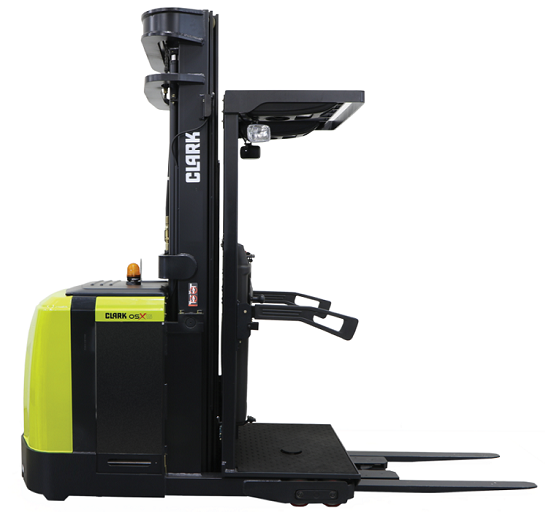 CLARK OSX – Order Picker |
 Big Joe – J1 Joey Task Support Vehicle |
5 Tips for Safe Order Picker Operation
We’ve covered safety tips for traditional forklifts in previous blogs, so we’re going to concentrate here on safety tips specific to operating stock/order pickers.
Unlike conventional forklifts, order pickers present a very different challenge because, with forklifts, only the load raises or lowers. With stock pickers, the operator is also raised to a potentially dangerous height. Here are some tips for safe stock picker operation.
 Training. We can’t emphasize this enough. Operators must be thoroughly trained on the use and capacities, and limitations of the machines they will be operating. Not only is this an OSHA regulation, but it’s common sense. The potential for injury is very high if these specialized units are misused.
- Know your order picker’s capacity and do not exceed it. For pickers with platforms and decks, know how much weight each can handle.
- Identify obstacles in your warehouse and have a plan for avoiding them. Driving a loaded stock picker through a narrow warehouse aisle can be a dicey operation. When possible, drive with the operator platform lowered. Be completely aware of overhead obstacles and pedestrians in the warehouse. If your warehouse has defined vehicle traffic lanes, respect them. Operator-assist technology such as guidance and positioning systems, geofencing, auto speed reduction, and auto stop can yield a definite improvement in stock picker safety and increase pick efficiency.
- Use all available safety equipment. All stock pickers that lift operators have safety harnesses. Use them! Close all operator area gates and bring all handles down to their horizontal position before moving. Wear the PPE that is appropriate for your warehouse’s environment. Safety gloves help get a secure grip on boxes and shield your hands while the unit is in motion. Hard hats and goggles prevent injuries from falling inventory. Slip-resistant boots provide firm footing while moving boxes, and high-visibility vests ensure that other vehicle operators see you.
- Keep both hands on the drive controls while the unit is in motion. This keeps you in control of the vehicle, especially if it is moving both vertically and horizontally simultaneously, and prevents hand and arms injuries when maneuvering down narrow aisles.
If you’re looking to select the right order picker for your warehouse, talk to the application specialists at Apex Material Handling. Apex is a certified dealer in the broad Chicago metro area for CLARK, Big Joe, and BYD forklifts and equipment. Talk to us about on-site training to ensure that your staff is fully equipped to employ industry best practices.
Apex is your one-stop shop for all your warehouse needs in the Chicago area. Call us at 833-226-4573 and let us help you create a more efficient and safer facility.