
An Average of 87 People Are Killed Each Year In Forklift Accidents
Although there is an annual Forklift Rodeo… you should never drive your forklift like a cowboy. In fact, the Forklift Rodeo focuses on skills designed to prevent forklift accidents. The winners are those operators that exhibit a high level of forklift safety.
In this blog, we’ll look at the 5 most common forklift accidents and explore how to use forklifts and configure facilities to minimize forklift accidents. It should be noted beforehand that the most effective way to prevent forklift accidents is to require that all forklift operators are thoroughly trained and have received certification on the specific type of powered industrial vehicle they will be operating. Apex offers various training programs to prepare your team for safe work.
1. Forklift Tip Overs
Tip overs or rollovers are the greatest cause of forklift-related injuries and product damage, accounting for 25% of those injuries. Forklift tip overs are usually caused by:
- Turning a forklift too quickly, especially a fully loaded forklift
- Uneven, unbalanced or overweight loads
- Abrupt forward or reverse mast movement
- Turning a forklift on an incline
- Driving a forklift with an elevated load
- Driving a forklift on an uneven surface
How to Avoid Tip Overs
- As mentioned above, there is no substitute for comprehensive forklift operator training. You will learn all the proper techniques for depositing or picking up a load, elevating or lowering a load, and driving with a load.
- Follow set speed limits. These limits were calculated specifically to prevent accidents. They should be rigorously followed.
- Slow down on corners. Once you’ve fully loaded a forklift, the center of gravity shifts drastically. That calls for extreme caution in making turns.
- Know your forklift’s weight capacity, and do not exceed it. Lack of awareness is no excuse. This parameter is clearly indicated on the forklift’s data plate.
- Understand how forklift attachments change the characteristics of your forklift. These move the center of gravity of a loaded forklift even further forward and demand driving diligence.
- Be very careful tilting a raised load forward or backward. This should be done slowly or momentum can cause the forklift to tip over.
- Don’t DWR–driving while raising a load. This is especially dangerous if you’re backing up.
- Never, ever turn a loaded forklift on an incline. No exceptions.
- Keep the load as low to the ground as possible when driving. It’s much more stable that way.
- Be aware of ground or floor conditions. Uneven surfaces, debris on the floor or potholes are recipes for disaster.
Read our blog on Forklift Safety Tips next.

2. Pedestrian Accidents
Pedestrian encounters with forklifts are the second most common type of forklift accident and are generally not very pretty. Forklift operators must be especially vigilant in busy warehouses with many workers scurrying around. Here are the main causes of forklift/pedestrian accidents.
- Operator inattention. This is usually caused by fatigue, distracted driving, or carelessness.
- Poor warehouse configuration. A lack of signals, alerts, or dedicated forklift and pedestrian lanes can contribute to workers getting nailed by a forklift.
- Runaway forklift. An unattended forklift that is not properly braked can roll away and hit racks, walls, and pedestrians.
Avoiding Pedestrian Accidents
- Once again, we can’t stress enough the value of forklift operator training. This is the single best way to prevent a pedestrian from becoming a statistic. Likewise, warehouse workers must be trained to coexist with forklifts.
- Be kind to your forklift operators. Operators should be allowed plenty of breaks, especially if they work at a breakneck pace from the start to the end of their shift. Be especially cautious if operators are working 12-hour shifts.
- Configure your forklifts for safety. Make sure your forklift has all appropriate safety “bells and whistles.” They should be equipped with working horns, backup beepers, blue strobe lights. For the highest level of safety, invest in some of the latest forklift/pedestrian interaction technology, such as forklift-mounted 360° cameras and proximity sensors. See our blog on Forklift Safety Tech.
- Configure your warehouse for safety. Use tape or paint to delineate safe pedestrian zones. Create separate forklift and pedestrian travel aisles with railings, if necessary. Employ pedestrian gates, ceiling-mounted alert sensors, lighted floor signs, mirrors and intersection stop/go lights.
3. Falling Loads
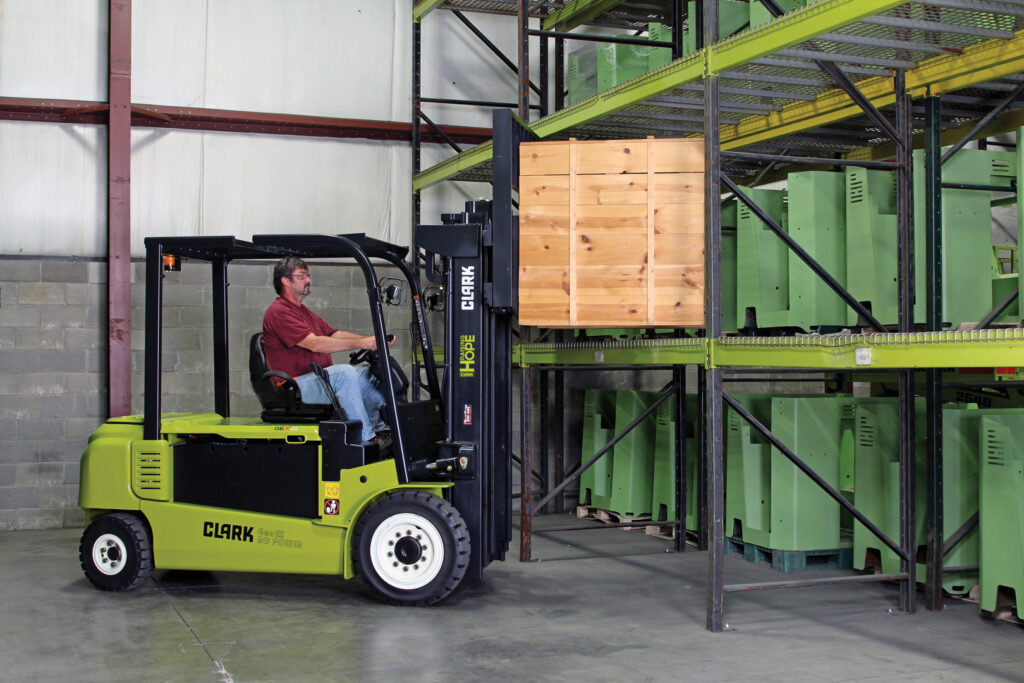
Another significant yet preventable forklift hazard is falling loads from elevated forks that can either injure the operator or a warehouse worker. Here are the primary causes –
- Improper loading – Unbalanced, overweight, damaged or loose loads.
- Moving a load without tilting the mast back – A load slipping off the forks as you back up can result in an unfortunate situation. Likewise, tilting the mast too quickly can cause the load to become unstable.
- No backrest on the forklift – It may start raining boxes on the operator.
- Forks bent or out of alignment – Your load may go slip-slidin’ away.
Preventing Loads from Falling
- Secure your load properly. Loose, damaged or improperly wrapped or bundled loads can be difficult to move safely. Don’t risk it.
- Center the load. If it can’t be centered, position the heavier end nearer to the front wheels, against the forklift’s carriage.
- Move the mast with care, whether raising and lowering loads or tilting the forks.
- During your pre-shift inspection, check to ensure the backrest is in place, the forks are aligned and not damaged, and the mast movements are smooth.
- Be especially careful with non-standard loads, like bulk items, raw materials, pipes, and conduits. Carefully secure them before attempting to lift, lower or move them.

4. Truck Falling From a Dock or Trailer
One of the most dangerous operations in using a forklift is loading and unloading a trailer at a warehouse dock. There are several things to be vigilant of to safely perform this important material handling operation.
- Trailer landing gear not properly engaged – The weight of the forklift entering the trailer can cause the gear to collapse, making the forklift and operator tumble to the ground
- Trailer wheels not properly chocked – This could cause the trailer to roll away as the forklift is entering, causing the vehicle and operator to take the plunge into the gap.
- Driver departing the dock while the trailer is being loaded – Another plunge into the gap.
- The trailer does not have the weight-bearing capacity to accommodate the weight of the forklift. Need we explain what could happen?
- Dock plate inadequate or not properly placed – Again, this could cause a visit to The Gap.
- Slippery floor conditions. The dock/trailer interface is sometimes subject to adverse weather conditions like rain, snow, or ice. The forklift could skid and collide with a wall or the side of the trailer.
Safe Trailer Loading and Unloading
- As you do when you start up your shift, you should have a checklist of safety items to be aware of before starting to load or unload the trailer.
- Check loading capacity of the trailer; check conditions of trailer floor for holes, cracks, and missing boards. Make sure the dock plate is securely in place.
- Ensure trailer wheels are securely chocked, and landing gear is locked. If your dock has a dock lock, make sure it is engaged.
- Establish communication with the truck driver. Stop/go lights at the dock door help.
- Drive slowly entering or exiting the trailer. If slippery conditions exist, use extra caution
Note: You can check out our blog on Safely Loading and Unloading a Trailer for more details.
5. Workers Falling From Elevated Forklifts

No matter how often it’s stressed that raising a person on the forks or pallet is dangerous, a substantial number of workers are killed or injured each year in that manner.
- Workers and forklift operators try to cut corners instead of locating the proper personnel lift equipment.
- Lack of availability of personnel lift attachment, scissors lift or mobile elevated work platform (MEWP)
Preventing Falls from Elevated Forklifts
- Locate the proper personnel lift forklift attachment. Ensure workers have closed all gates and secured a harness to the cage’s frame.
- If the proper attachment or lift is unavailable, alert management and wait for the proper equipment to become available.
These are just the main causes of forklift accidents, but there are many more: collisions caused by the load blocking the operator’s view, mechanical problems such as worn-out brakes, steering or masts, burns from mishandling battery acid and being overcome by fumes by using an IC forklift indoors.
Apex offers many tools to help your company operate its forklift fleet safely and efficiently: Operator training and certification. Facility, fleet safety pallet rack safety audits. Pre-shift checklists for all types of material handling and elevated work platform equipment. In the Chicagoland area, Apex is your full-service warehouse and material handling resource.