
Manual Pallet Jacks Fill a Broad Range of Less-Than-Forklift Applications
Manual pallet jacks are versatile, user-friendly tools ideal for a variety of low-level, light-duty tasks. You will often see these handy material handling tools in manufacturing, warehousing, and service facilities—pretty much any organization needing a simple solution for moving palletized materials short distances.
Choosing the right manual pallet jack involves a bit more thought than you might initially expect. Important factors include load type and weight, along with whether to purchase or lease your equipment. Additionally, even though manual pallet jacks aren’t powered, improper use can still lead to operator injuries, making training essential. Finally, like all material-handling equipment, manual pallet jacks require regular care and maintenance to stay reliable and safe.
Let’s look at the basic elements of a manual pallet jack and some of the upgrades and options available.
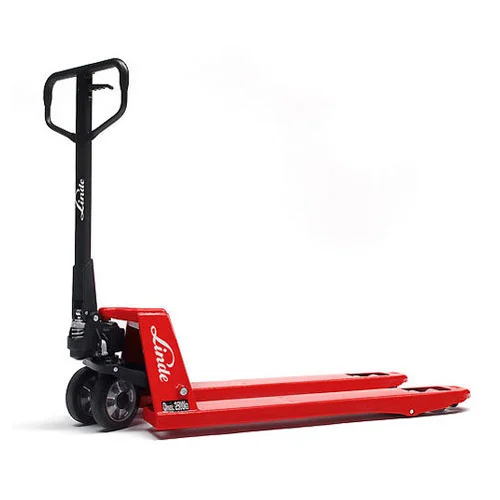 The Manual Pallet Jack, Disassembled
The manual pallet jack has three moving parts: the hydraulic lift, the steering mechanism, and the wheels that carry the load from point A to point B.
The main elements of a manual pallet jack are the following:
- Forks – Naturally, these are what the pallet rests on.
- Handle – The operator uses the handle to raise or lower the load, steer it, and pull or push it to the desired destination.
- Wheels – Manual pallet jacks have large double-drive wheels at the position of the handle.
- Rollers – The pallet jack forks have rollers near the tip to stabilize a load.
- Hydraulic mechanism – Manual pallet jacks have a hydraulic pump, actuated by a lever on the handle, that lifts or lowers the load.
Key Manual Pallet Jack Parameters
When buying or specifying a manual pallet jack, it’s important to make sure it meets your needs. Here are the specs you should consider.
Capacity – Manual pallet jacks generally have a lifting capacity ranging from 2,000 to 5,500 lbs, suitable for a wide range of industrial and warehouse applications.
Note: Heavy-duty pallet jacks are available with capacities up to 10k—12k lbs. If your loads are consistently at max capacity for a standard manual pallet jack (5K or so), a heavy-duty jack will perform better and last longer. However, that’s a lot of weight for a human to push and pull, so we’d recommend opting for an electric pallet jack unless you’re moving materials in very short distances and on smooth, flat floors.
Fork Length and Width – Manual pallet jacks typically feature standard 48-inch long forks, though options with shorter 24-inch forks are available for specialized applications. The width across the forks ranges from a standard 27 inches edge to edge, with 15 inches between the forks. However, models are also available with narrower dimensions, such as 20 inches across the forks and 8 inches between them, catering to specific needs.
Wheel Material – Rubber or polyurethane wheels and rollers are available. The choice depends on the surface over which the pallet jack will operate.
Lift and Lower Heights—Most manual pallet jacks are designed to lift a pallet off the floor for transportation. In the lowered position, they feature forks that hug the floor, with the top of the forks generally about 2½ to 3 inches above the floor. When raised, a pallet jack’s forks elevate a load only about 8 inches off the floor.
Specialty Manual Jacks
Scissor-lift jacks (also known as hi-lift manual pallet jacks) can raise loads up to approximately 30 inches, making them ideal for lifting pallets to table-height workstations, feeding materials into machinery, positioning goods for inspection, and loading onto trucks with higher bed heights.
Pallet Jacks with built-in scales are uniquely handy in applications where your load is frequently at capacity, or if the palletized product has weight limits/restrictions.
Stainless steel manual pallet jacks are a good option for food service applications where wash-down compliance is required.
Step-by-Step Guide to Using a Manual Pallet Jack
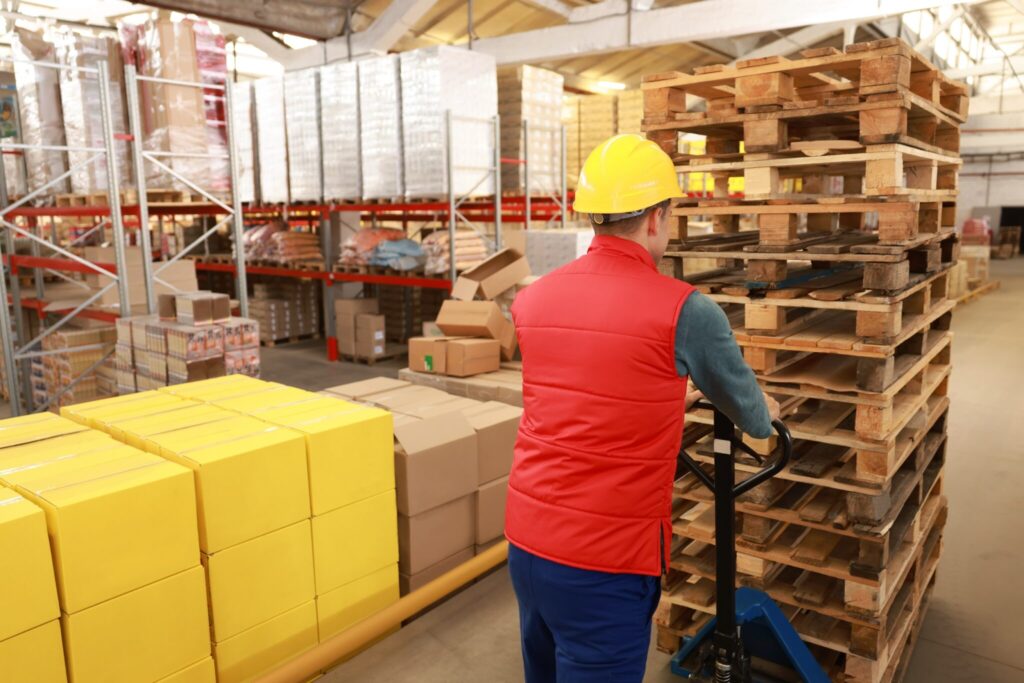
- Locate the lever, generally located on the handle. The lever has three positions: lower, neutral, and lift. Pull the lever up to lower the forks to floor level.
- Position the forks under the pallet. Be certain that the forks of the pallet jack and the openings in the pallet match up. Center the forks in the pallet and make sure the load is intact so that lifting it won’t cause items to fall off.
- Lift the load by moving the lever to the down, or pumping, position and pump the handle. Lift the load just enough to clear the floor and move the pallet jack. Once the load is lifted, move the lever to the middle or neutral position.
- Carefully pull or push the load to the desired location.
- Upon arrival at the destination, move the lever to the upper position. Slowly release the handle to lower the load. Jerking the handle too quickly can cause the pallet to hit the floor abruptly, potentially damaging the load and pallet or causing items to topple.
Safety Considerations for Using Manual Pallet Jacks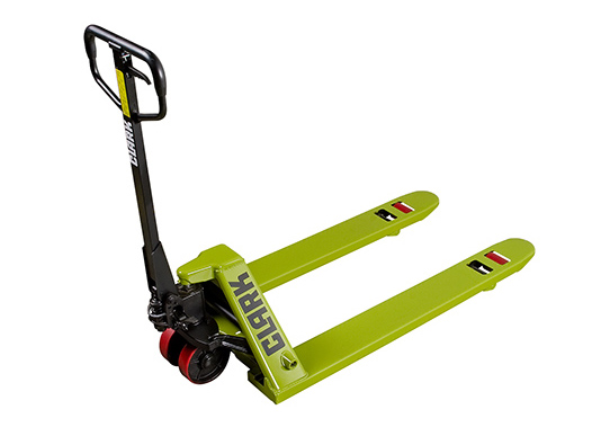
- Along with the safety items mentioned in the previous section, manual pallet jack operators should be careful not to injure themselves by trying to push or pull a loaded pallet jack that is beyond their physical ability.
- Be aware also that a heavily loaded pallet jack develops momentum once it’s in motion and will require a certain amount of stopping distance.
- A pallet jack can turn on a dime. That doesn’t mean you should do that. Turning a moving pallet jack too quickly can cause your load to topple over.
- Invest in training. Apex offers training in operating all sorts of forklifts, including manual pallet jacks.
Maintain Your Pallet Jack Properly
Like any forklift, proper maintenance of your pallet jack will yield a longer useful life and smoother operation. Clean the pallet jack regularly to remove debris and dirt that collects in the transport mechanisms. Wheel shafts and bearings should also be lubricated on a scheduled basis. Hydraulic fluid can evaporate or deteriorate over time. Check the manufacturer’s specs on topping up or replacing hydraulic fluid. If you have a fleet of pallet jacks, consider hiring Apex to maintain the fleet.
Rent, Lease, or Own?
While pallet jacks are relatively inexpensive items compared to forklifts, you should still decide whether your level of usage of these manual pallet movers warrants owning or leasing them. Often, companies need manual pallet jacks for seasonal use, so renting makes the most sense. Apex offers a deal for any of those options.
Ready to Move Forward? Call Apex!
Manual pallet jacks are a smart, cost-effective solution in specific warehouse environments—especially when:
- You only move a few pallets per day
- Space is tight or maneuverability is limited
- You’re working with a lean budget
- You’re in a low-tech or non-electric facility without storage or charging capabilities for electric pallet jacks
However, if you frequently transport heavy pallets over longer distances, an electric pallet jack—or even better, a walkie-rider—can significantly improve efficiency and reduce operator fatigue.
At Apex, we’ve got you covered. We offer a wide variety of forklifts, from manual pallet jacks to telehandlers, along with flexible financial options to suit your needs — whether you prefer to rent, lease, or buy.
Apex also offers contract maintenance services, replacement parts, training, and fleet management, all designed to make your material handling operation a breeze! When the question is material handling, the answer is Apex—Contact us today!