From Maintenance Tips to Long-Term Performance: Unlocking the Power of Electric Forklift Batteries
Battery-operated material handling vehicles have been around since the early 1900s, but the development of the modern electric battery-powered forklift accelerated after World War II. By the 1950s, the lead-acid battery forklift as we know it today came into wide use.
In an electric battery-powered forklift, the battery does it all. It provides the energy to propel and stop the forklift and to raise and lower the load. Additionally, because of its weight, generally over 2,000 lb., it is also used to counterbalance the carried load. It is crucial to ensure that the battery falls between the forklift’s recommended battery weight range found on the nameplate of the truck. If a battery is too heavy or too light it can change the truck’s center of gravity and cause it to be unstable.
How are Lead-Acid Batteries Constructed?
Lead-acid batteries are composed of a series of cells. Each cell contains a lead dioxide (positive) plate, also known as the cathode, and a sponge lead (negative) plate, the anode. The plates are separated by a thin polymeric insulator. The cell is flooded with a sulfuric acid and water solution known as an electrolyte. This lead-acid electrochemical system creates a potential energy difference of 2 volts between the plates.
Forklift batteries are constructed with a series of these cells to create a battery of anywhere from 12 volts to 80 volts. A 24-volt battery will have 12 cells, while an 80-volt battery will have 40. The higher the voltage, the greater the battery’s power potential. The size of the plates also determines the battery’s ability to deliver power. The larger the plates, the greater the amount of current that can flow from the anode to the cathode.
The cells are hooked up in series with terminals on the positive and negative ends from which the battery delivers electrical power.
A Lead Acid Battery Consists of:
- Two or more cells, connected in series
- Each cell is two (2) volts
- 12 Cell Battery = 24 Volts
- 18 Cell Battery = 36 Volts
- 24 Cell Battery = 48 Volts
A Cell Consists of:
- Alternating positive & negative lead plates
- Always 1 more negative than positive
- Plates are separated by microporous separators for electrical insulation
- Sulfuric Acid
- Diluted solution of sulfuric acid and water
- Approximately 37% acid
How Does a Lead-Acid Battery Work?
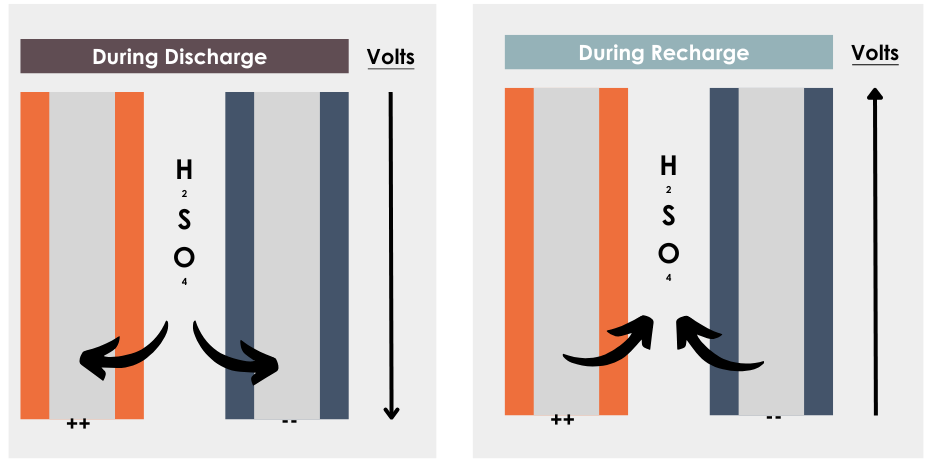
As a load or resistance is applied to the battery terminals–such as driving a forklift or lifting a load–electrons flow from the negative anode to the positive cathode. In this process, the battery becomes discharged, both plates are converted to lead sulfate, and the electrolyte becomes depleted.
Charging a lead-acid forklift battery reverses this process, restoring the plates to their original chemical composition and restoring the acidity of the electrolyte.
The process of charging and discharging a battery is known as a ‘cycle’. Lead-acid batteries are generally designed to last 1500 to 1800 cycles.
How Do I Get the Longest Life Out of a Lead-Acid Forklift Battery?
Lead-acid electric forklift batteries require a specific set of protocols to achieve their optimal lifespan. In general, a fully charged lead-acid battery will give you 6 to 8 hours of high-intensity service. This needs to be followed by 8 hours of charging the battery and 8 hours for the battery to cool down.
Charging
Batteries should never be discharged to below 80% of their rated capacity, as frequent over-discharging can drastically shorten battery life. Recalibrating the forklift’s BDI to ensure the battery doesn’t get below 20% state of charge (SOC) before the lift interrupt kicks in is one way to help protect the battery. On the reverse side, it is just as important to have a properly sized charger to eliminate overcharging the battery, which will create excessive heat and gassing. Most high-frequency chargers today are considered “smart chargers” with automatic start/stop functions to help eliminate under and overcharging.
Watering
Since the electrolyte tends to evaporate during the discharge and recharge process, lead acid batteries need to be topped off with deionized water regularly. Recommended watering intervals are once every other week but can vary depending on the application. Watering should only be done at the end of the charging cycle when the battery is fully cooled.
The electrolyte level should cover all the plates to prevent them from oxidizing but should also be ¼ in. below the vent cap to prevent boiling over.

There are two methods of watering a battery: manual and automated. In manual watering, the technician opens each vent cap and manually adds water. With an automated system, or single point watering system (SPWS), all vent caps are connected to a single manifold. Floats or valves in each cell determine if the cell needs water and automatically shuts off once desired electrolyte level is reached.SPWS are a much safer and faster way to water batteries.
Equalization
Lead-acid batteries also require equalization. Due to the individual cell’s construction, some will discharge at slightly different rates or take less charge than others. So, an equalization charge is recommended once per week to help balance the cells back out and bring them to the same capacity. It is simply a 3-hour continuation of the standard recharge at a very low, trickle charge rate to force the remaining acid out of the plates.
Equalization is a controlled overcharging of the battery. A charger system specifically designed for equalization, containing both temperature and voltage measurements, provides the safest and most effective way to equalize a battery.
Maintenance and Inspection
Batteries should be inspected before each shift, in addition to watering and equalizing. Terminals should be kept clean and free of corrosion. Broken or frayed battery cables must be replaced. Leaking or cracked batteries should be removed from service. Electrolyte spills or overflows should be carefully cleaned using proper personnel protection equipment, such as gloves, aprons, and goggles.
Battery Specifications–How to Spec Replacement Electric Forklift Batteries
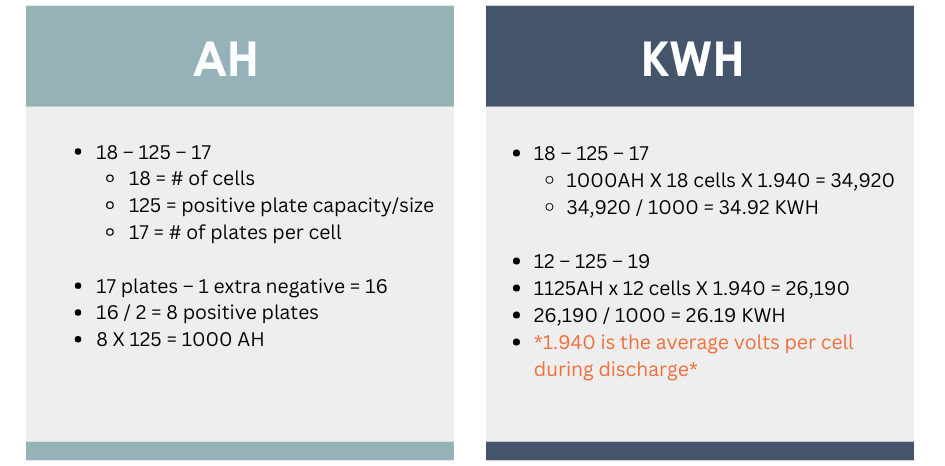
Batteries have three main specs–voltage, capacity in amp-hours (AH), and weight. Battery nomenclature is represented by three sets of numbers, such as 18-125-17. The first number indicates the number of cells, and thus is an indication of the voltage of the battery, in this case 36 volts. Remember, 2 volts per cell. The second number indicates the size and, thus, the capacity of the plates. A higher number indicates a larger battery. The last number is the number of plates per cell which is uniquely odd since batteries have one extra negative plate per cell. A battery with 29 plates/cell has a higher capacity than one with 17 plates/cell.
Using the foregoing numbers, one can calculate the capacity of the battery in AH and KWH. See the example below.
Determining Battery AH & KWH
Do you have a truck with multiple voltage options?
Other factors in battery specification are the position of the cables (A-B-C-D), the required cable length, and the type of connector.
How to Spec a Battery Charger
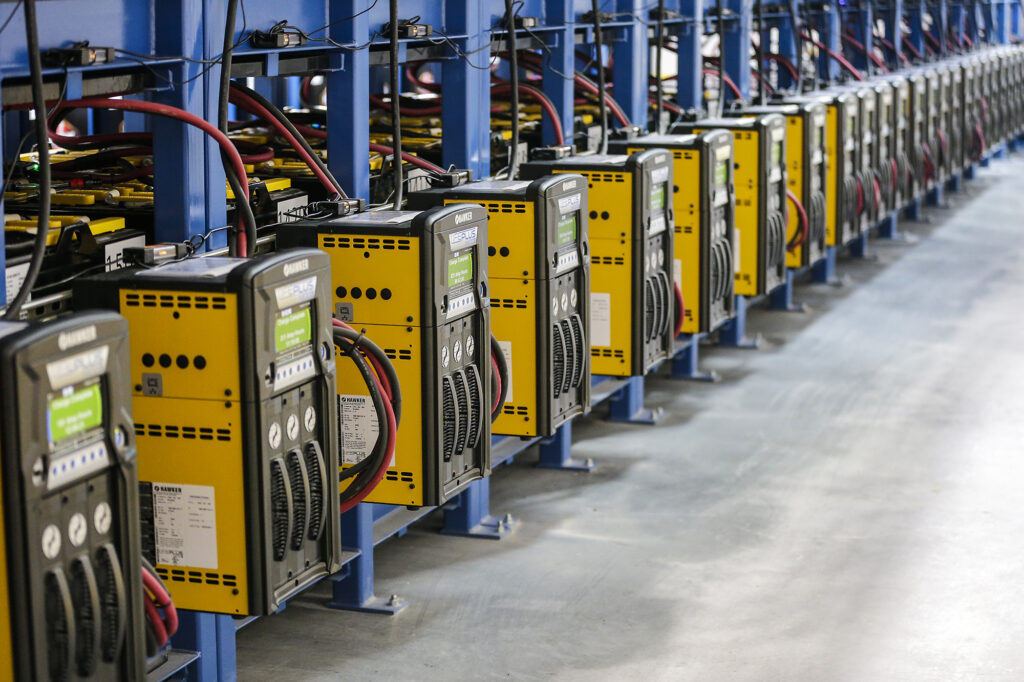
Once you know your battery’s voltage and capacity in AH, you need to use a charger that matches the voltage and has the capacity to properly charge and equalize the battery. Standard or conventional chargers have a lower start rate and typically follow the 8-8-8 rule. Use the battery for 8 hours, let it charge for 8 hours, then let it cool down for 8 hours. Also, check the input voltage. Verify that your facility has the required power to hook up the charger.
Opportunity and fast chargers deliver a higher initial start rate to put more AH back into the battery in a shorter amount of time. Depending on the application, going to an opportunity charge start rate or higher can eliminate the need for battery changes.. However, these fast charging methods will shorten the battery’s life.
Customer usage?
- Conventional Charge
- 16% start rate
- Opportunity Charge
- 25% start rate
- Fast Charge
- 26% start rate or higher
- Lithium
- 50% start rate or higher
- Confirm customer AC infrastructure
- Match battery connector
- Equalize settings
What About Lithium-Ion Batteries?
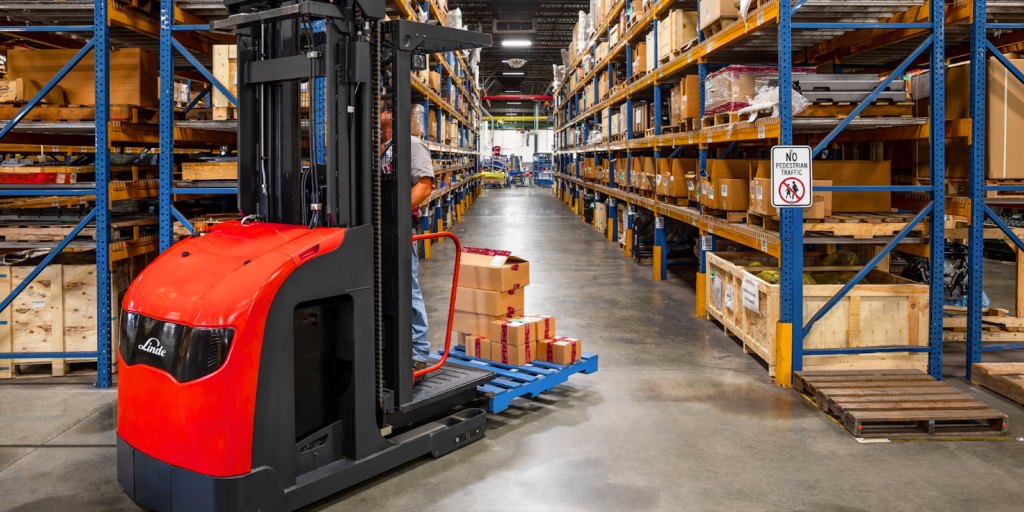
Initially, lithium-ion batteries were used for light-load forklifts and pallet jacks. However, their capacity has improved significantly over the past decade to the point where they can compete with lead-acid batteries for nearly any application. They are maintenance-free, offer a longer lifespan, charge up quickly, and free up space in your facility that was previously used as a charging area or battery storage room.
Lithium-ion batteries are also much safer than lead-acid batteries by eliminating the need to remove and recharge a 2,000 lb. battery and contend with a caustic acid solution. The downside to lithium-ion batteries is their upfront cost–nearly twice that of lead-acid batteries–and the lack of a recycling infrastructure, although that is starting to change. Also, being much lighter than lead-acid batteries, lithium-ion batteries often require additional counterweight or steel added into the tray when replacing a lead-acid battery to maintain the forklift’s lifting capacity.
When to Consider Lithium-Ion Batteries
- When lead acid can’t keep up!
- Other factors Include:
- Safety- Eliminate battery changes = eliminate battery drops
- Maintenance-free – No need for internal maintenance
- Eliminate battery room
- Regain valuable floor space
- Save on costly equipment
- No need for proper ventilation & water access
If You Need a New Electric Forklift Battery or Charger…
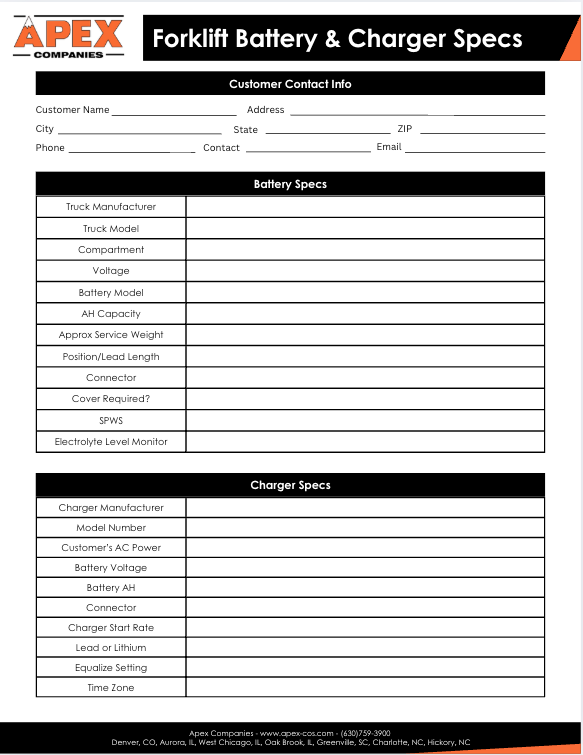
By filling out one of the two forms below, you’ll give us all the information we need to specify a replacement for your electric forklift batteries or chargers. Apex maintains a large inventory for nearly every application. Contact your Apex rep today to learn more about purchasing, renting, and financing a new battery or charging system. Apex is your nationwide material handling superstore.