
Forklift Types – Finding Your Vehicle Among the Many Options
If someone were to tell you that there are more than a hundred forklift types –would you be surprised? Well, prepare to be surprised because, indeed, there are over 100. Vehicle power sources, lift capacity, number of wheels, and automation capabilities are just a few of the distinguishing features. With so many choices, it can be a challenge to feel confident that you are getting the best vehicle for your needs and spending your capital wisely.
A trusted sales contact is a valuable resource (shout out to the Apex team), but it’s also wise to know what you can about potential forklift models and their capabilities to ensure you ask the right questions and strike the best deal.
OSHA Classifications
OSHA organizes forklifts into seven classifications, so that’s a good place to start breaking down the various types. OSHA uses the classifications to set safe operation standards for vehicles based on features such as gas or electric power, terrain, operator function, etc.
- Class I: Electric Motor Rider Forklifts – includes sit-down rider forklifts and stand-up counterbalance trucks
- Class II: Electric Motor Narrow Aisle Forklifts (Reach Trucks, Order Pickers)
- Class III: Electric Pallet Jacks, Stackers, and Tow Tractors
- Class IV: Internal Combustion Cushion Tire Forklifts
- Class V: Internal Combustion Pneumatic Tire Forklifts
- Class VI: Electric/IC Engine Tow Tractors
- Class VII: Rough Terrain Forklifts
OSHA requires that operator training and certification be based on the vehicle class, so ensure your team is adequately credentialed to operate any material handling equipment that you purchase.
Forklift Types
Class 1 – Electric Motor Rider Trucks
Vehicles:
Rider forklifts – choose between sit-down or stand-up operation. Vehicles are multi-directional and move forward, backward, laterally, and diagonally.
Counterbalance forklifts – choose between sit-down or stand-up operation. The vehicle design features one or two rear wheels and a set of forks mounted to the mast at the front. The counterweight at the back compensates for the weight of the load being lifted and helps maintain overall balance while operating. This type of truck typically has a very low center of gravity and can handle much heavier loads than other styles, such as rider or electric pallet jacks.
Function: lift and transport large or heavy materials – best for short distances
Features: electric motor provides extended battery life and less maintenance cost vs. internal combustion (IC) vehicles.
Advantages:
- Zero emissions –ideal for indoor operations
- Cost-efficient – uses less energy to move heavier loads than ICs
- Standard safety features
Examples of Class I Forklifts
|
|
|
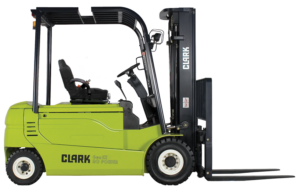

| CLARK Counterbalance Electric Forklifts | BYD ECB Electric Forklifts |
Class II – Electric Motor Narrow Aisle Forklifts
Vehicles:
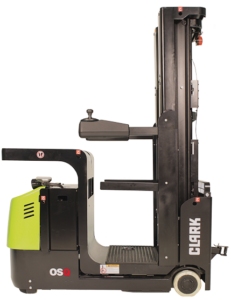
Order Pickers – specialized forklifts designed for order fulfillment and typically used in warehouses and have the ability to reach high shelves, allowing workers to transport items from one place to another quickly and easily.
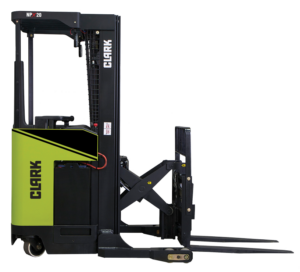
Reach Trucks – specialized narrow aisle lift truck that allows operators to move materials within very confined workspaces, such as the inside of pallet racks or shelving systems. These trucks use counterbalance technology that keeps them stable while maneuvering around tight corners and operating in tight spaces.
Turret Trucks – powered industrial vehicles with two forward-facing forks that can rotate up to 180 degrees and provide increased flexibility.
Swing Mast Trucks – Able to rotate the mast assembly that houses the forks enabling operators to handle large loads in tight spaces and access hard-to-reach areas where traditional forklifts cannot reach.
Function: designed to work efficiently in tight spaces and can be used for a variety of tasks, including loading, unloading, stacking, and reaching into high places
Features: motors provide the power necessary to lift heavy loads quickly and efficiently while navigating through narrow aisles
Advantages:
- Fully adjustable mast heights
- Tight turning radiuses
- Ergonomic design
- Easy-to-use controls enhance operator safety and productivity
Examples of Class II Forklifts
 |
 |
 |
| CLARK Narrow Reach Trucks | CLARK OSX Order Picker | Big Joe Joey Order Picker |
Class III – Electric Pallet Jacks, Stackers, and Tow Tractors
Equipment:
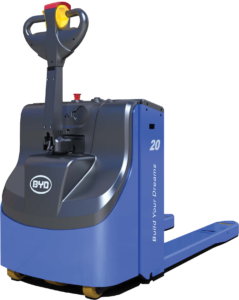
Electric Pallet Jacks – motorized hand trucks that lift and move pallets of goods
Stackers – machines designed to lift pallets of goods to higher levels for storage
Tow Tractors – pull trailer loads of goods and materials on flat surfaces such as roads or parking lots
Function: nimble and designed to help reduce the physical effort and improve productivity for stacking and unloading items, and moving items particularly over short distances. They are compact and, therefore ideal for maneuvering within tight spaces.
Features: motorized, rider, walk behind –options abound in this category
Advantages:
- Improved efficiency
- Less labor-intensive
- Minimize risk of worker injuries
- Access to tight spaces
 |
 |
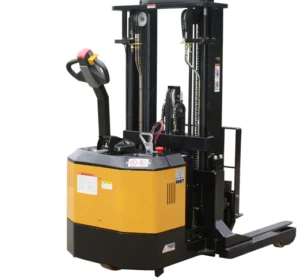 |
| CLARK Stacker | BYD Pallet Truck | Big Joe Stacker |
Class IV – Internal Combustion Cushion Tire Forklifts
Vehicles:
These vehicles are defined by their internal combustion engines that run on either liquid propane gas (LPG) or compressed natural gas (CNG). Gas-powered cushion tire forklifts offer many advantages such as increased performance, improved fuel efficiency and minimal environmental impact compared to traditional diesel units. The cushion tire provides a smoother ride for operations that are inside for all, or most of the time. They are much more ergonomic than traction tire counterparts.
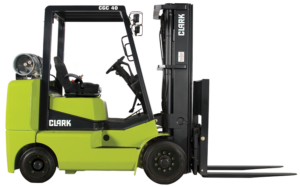 Styles include:
Sit-down rider – Gas, LPG, or Diesel (higher capacity vehicles)
Counterbalance forklifts – Gas, LPG, or Diesel (higher capacity vehicles)
Function: maneuver around tight corners, up to high racking shelves, and through narrow aisles with ease
Features: ability to maneuver in tight spaces and lift heavier loads than electric models
Advantages:
- Low-clearance
- Side-shift attachments
- Adjustable mast height
- Powered fork positioning
- Hydraulic steering and tilt cylinders
Class V Vehicles – Internal Combustion Pneumatic Tire Forklifts
Vehicles:
Increase safety and productivity in any workplace thanks to their reliable performance and heavy-duty lift capacity. While pneumatic tire vehicles are most often used outdoors, you can use your vehicle indside and your tires will provide some extra comfort for the vehicle operators.
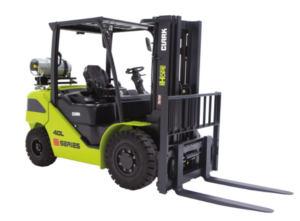 Styles include:
Sit-down rider – Gas, LPG, or Diesel (higher capacity vehicles)
Counterbalance forklifts – Gas, LPG, or Diesel (higher capacity vehicles)
Function: provide a safer operation by providing tires that are treaded for better traction, larger to handle uneven surfaces and pavement cracks, and durable in settings with debris (rocks, etc.)
Features: air filled pneumatic or solid foam-filled tires
Air filled pneumatic tires allow smooth movement over uneven terrain and surfaces. They also provide an excellent grip on the ground surface, enabling operators to safely navigate even difficult terrain or slippery surfaces with ease when hauling or towing loads.
Solid or “foam-filled” tires function with similar cushion results as their pneumatic counterparts but they have 3 to 4 times the durability depending on the application They are a great choice where you have a high risk of flats or rapid wear.
Advantages:
- Great maneuverability
- Low cost of ownership – long lifespan
- Minimal maintenance
- Operator comfort
Class VI – Electric/IC Engine Towing Tractors
Vehicles:
Towing Tractors – Heavy-duty towing vehicles featuring precision steering mechanisms, adjustable speeds, and powerful motors that provide enough force for pulling even the heaviest objects over rough terrain. Their rugged construction makes them ideal for continuous operation even in harsh conditions like extreme heat or cold temperatures.
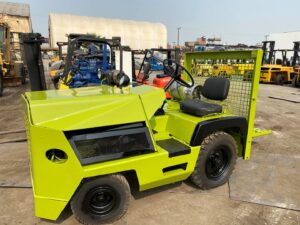 Function: specialized vehicles used to tow heavy loads
Features: strong frame, powerful engine and robust suspension make them suitable for hauling large materials
Advantages:
- Precision steering
- Adjustable speed controls
- Heavy-duty capacity
- Stability – low center of gravity
- Cost-effective – require less manpower
Class VII – Rough Terrain Forklifts
Vehicles:
Rough Terrain Forklifts – Typically utilize all-terrain tires and have a high ground clearance which helps them traverse challenging conditions. Most rough terrain forklifts are designed for lifting heavier loads than those of an indoor counterpart making them ideal for moving pallets, large crates, and other bulky items over long distances without having to worry about stability or maneuverability.
 Function: used to lift and move loads in outdoor, off-road environments
Features: rugged design which allows them to navigate uneven surfaces like mud, gravel or grass
Advantages:
- Upgraded safety features protect against rollover
- Indoor or outdoor use
- Heavy-duty suspension
- Safely tackles steep inclines
Contact the Apex experts for all your material handling equipment needs. We offer top-quality vehicles and knowledgeable staff to help guide your decision. We also offer favorable leasing and rental terms to help you finance your purchase and maximize your spending capital.