
Forklift Ergonomics Play a Key Role in Worker Satisfaction
Operating a forklift can be a long slog of repetitive activity. Spending an entire shift seated behind the forks can negatively affect your physical and mental well-being. That’s why it’s important to pay attention to forklift ergonomics when you purchase a fleet of forklifts or purchase a used one. And once you’ve deployed your shiny new fleet, you should check in on a regular basis to ensure that their ergonomics have not been compromised.
As your primary choice in material handling products and services in the Chicago area, Apex is pleased to provide you with this primer on forklift ergonomics.
Choose Your Forklift With Care
You have choices when you buy a forklift–size, capacity, weight, power source, and more. However, buyers often overlook one of the most important aspects of operating a forklift: will the operator be comfortable and be able to provide a full shift of high productivity work? When buying a forklift, you’d be smart to consider the following:
- Forklift Seat – The forklift seat is #1 in terms of operator comfort. Ensure the forklift has a full suspension seat with multiple height, position, angle, and lumbar support adjustments. The forklift seat can make your operator’s workday a pleasure or a pain.
- Easy Access – Buying a forklift with a low step-in height makes it easier for the operator to get in and out of the forklift and will reduce fatigue over a full shift
- Ample Cab Space – Your new forklift should have enough cab space for size XL operators to be comfortable while working.
- Level of Vibration – Driving a vibrating vehicle over a period of time can create both physical and mental stress. Select a forklift that drives and lifts smoothly. Electric forklifts are preferable, since they offer a minimal level of vibration.
- Easy-to-use Controls – Forklift manufacturers have done a good job in making control levers and joysticks easily accessible and easy to use. Check that your new ones do.
- Steering wheel – Look for steering wheels that offer angle and tilt adjustments or that telescope for ease of exit. Steering should be smooth and accurate.
- Adjustable Armrests – Not only should they move up and down, but be easily folded up to allow the operator to reach out to pick items off racks–especially important when buying a stock picker.
- Visibility and Sight Lines – Assure that your forklift allows the operator a good view of what’s ahead as well as what’s behind. Forklifts should be equipped with mirrors or with rear-view cameras to minimize the amount of twisting an operator has to do to see what’s behind the vehicle.
- Suspension System and Tires – If your forklift will operate over uneven or rocky terrain, be sure your forklift is equipped with a rugged suspension system and tires to match.
- Rain Caps or Enclosed Cab – If your forklift is going to be used outdoors, invest in a rain cap or a fully-enclosed, heated or air-conditioned cab if ambient weather conditions call for it.
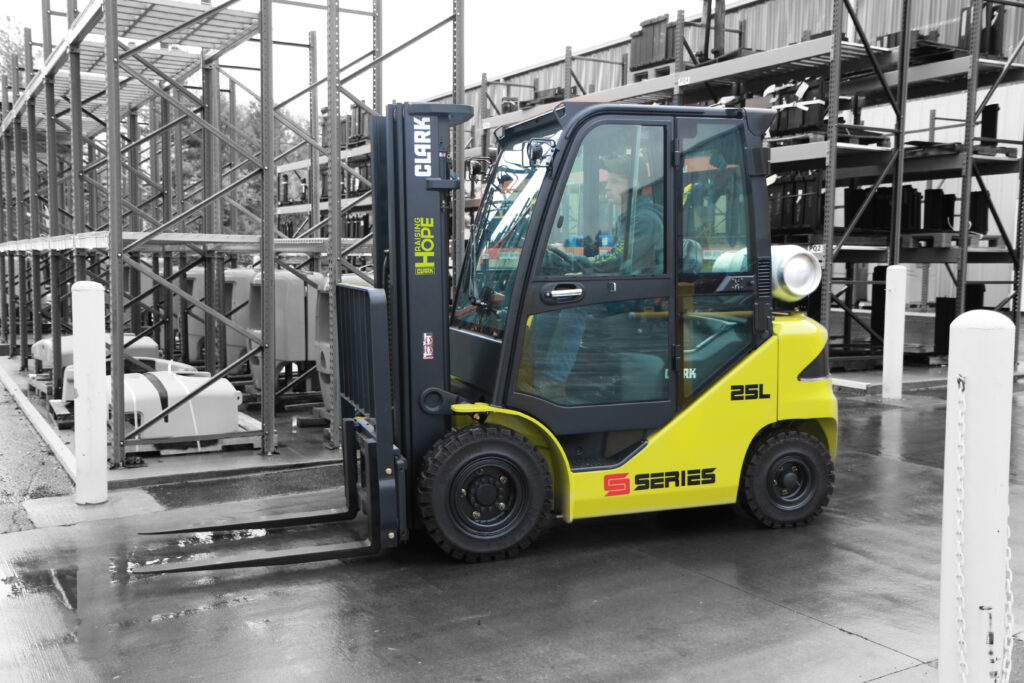
Practice Safe and Ergonomic Forklift Operation
How you operate a forklift can also contribute to poor ergonomics. Operators should be trained to know what practices increase fatigue and contribute to poor productivity. Here are just some of the things operators should know to do:
- Avoid rapid acceleration and abrupt braking – These can jar the body and cause fatigue and injury. Don’t be a speed freak.
- Set up your forklift – Take the time to adjust the seat, armrest, mirror, and controls for the most comfortable working position. Craning your neck, stretching, or twisting over an eight-hour shift can be exhausting.
- Always do a pre-shift inspection – Make sure driving and lifting are smooth and jerk-free. A bumpy ride can be fatiguing. Check tires for dings, bumps, and underinflation.
- Check and replace faulty items – A forklift can last ten years, a forklift seat…maybe not as much. If the seat is worn or ripped, and the adjustments don’t work, replace it. If mirrors are cracked or hazy from age, get new ones.
- Use the three-points of contact rule – When you mount or dismount the forklift, always face the cab and have three contact points. Anything else can be unsafe and tiring.
- Take breaks or rotate tasks – If you have the opportunity to switch to a different task for a period of time, take it. Many pallet jacks and stock pickers require the operator to stand. That can offer relief from hours of sitting on a forklift.
- Wear the proper clothing – If you’re going to be operating the forklift in inclement weather–rain, snow, heat, or cold, make sure you are dressed for the occasion. Physical discomfort can cause you to lose focus and make mistakes.
- Make your life easier – Make sure your forklift is properly equipped with clipboard, cup and pen holders, manuals and other documentation you need during your shift.

Training your forklift operators to be cognizant of forklift ergonomics, as well as safety, productivity, and mechanics is the best way to maximize the efficiency of your warehouse or material handling operation and improve worker safety and morale. Apex offers you all the training you need to get the greatest return on your investment in a forklift fleet. If you’re in the Chicago area, Apex is your best resource for warehouse and material handling products and services. Just give us a call at 833-226-4573.